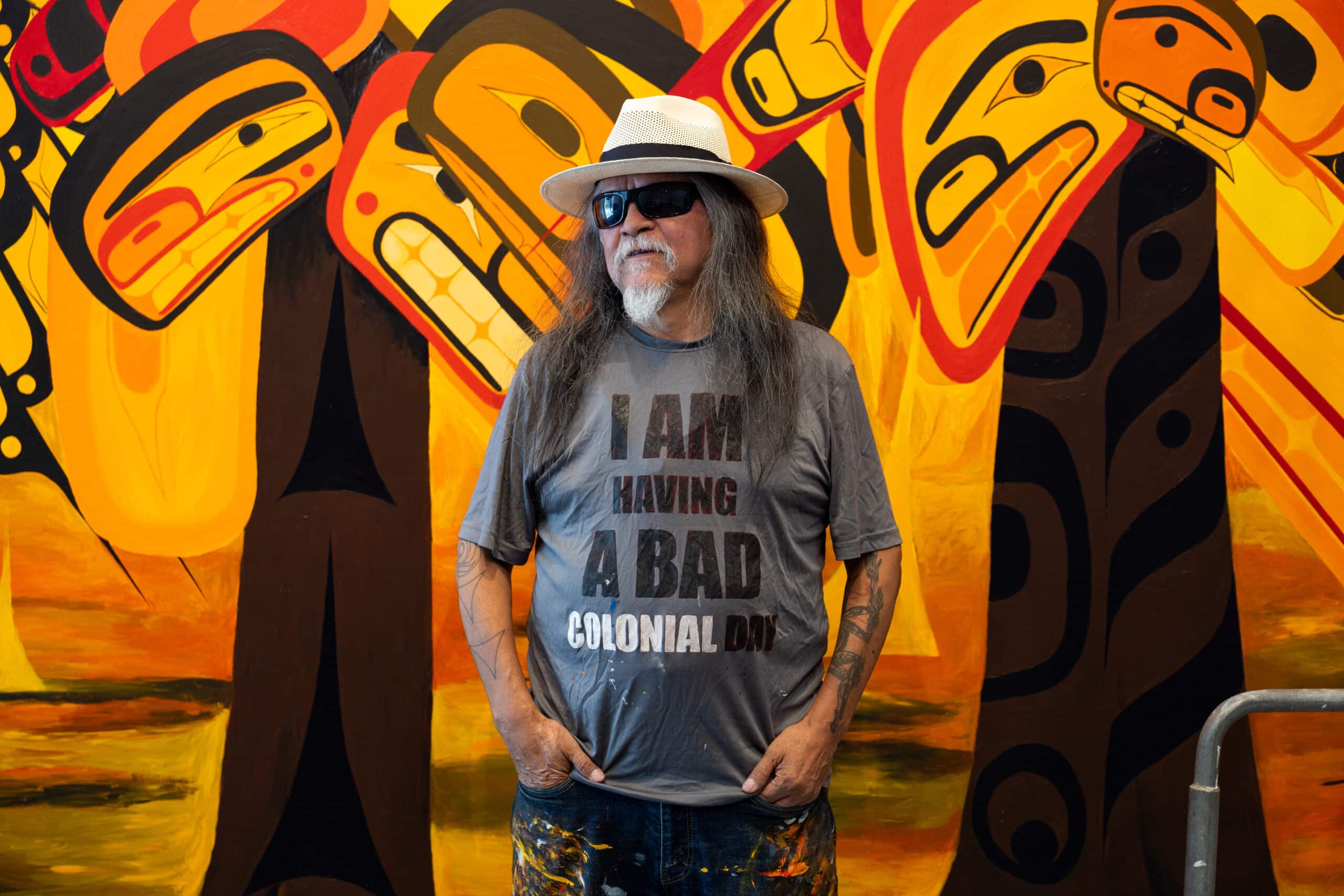
Throughout the summer, the celebrated artist, ECU alum and Honorary Degree recipient has been at work on a towering new painting at the Libby Leshgold Gallery as part of a 2026 residency.
On a Friday in the Libby Leshgold Gallery at Emily Carr University of Art + Design (ECU), Lawrence Paul Yuxweluptun Lets’lo:tseltun, wearing a paint-spattered t-shirt and jeans, leans back in a stack chair. His long silver hair skews orange in the light reflected from the monumental painting-in-progress beneath which he sits, its vertical edge stretching nearly the entire height of the gallery’s three-storey walls.
Titled Global Warming: Wildfire Storms, the painting is the latest in Lawrence’s Fire Painting series and is being completed as part of his open studio residency at the gallery through the summer.
“It’s this moment in time,” Lawrence says. “This is the time of fire season, but is it a natural fire season? What part does global warming play? The fire season is a normal act that we’ve had since the beginning of time. But when did it become manmade? This is a world event.”
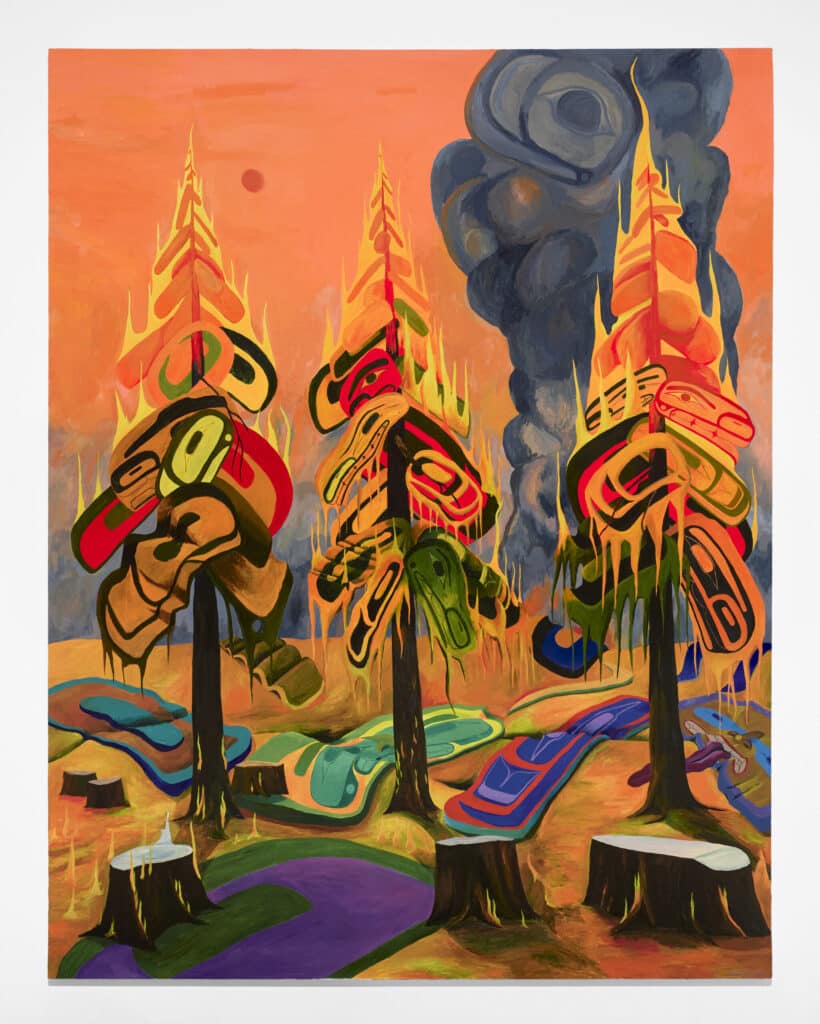
Lawrence’s residency marks the beginning of an international partnership supporting the production of new work by three artists from the Pacific Northwest for a future presentation in 2027. Global Warming: Wildfire Storms will also be exhibited at the Libby Leshgold Gallery in Fall 2026.
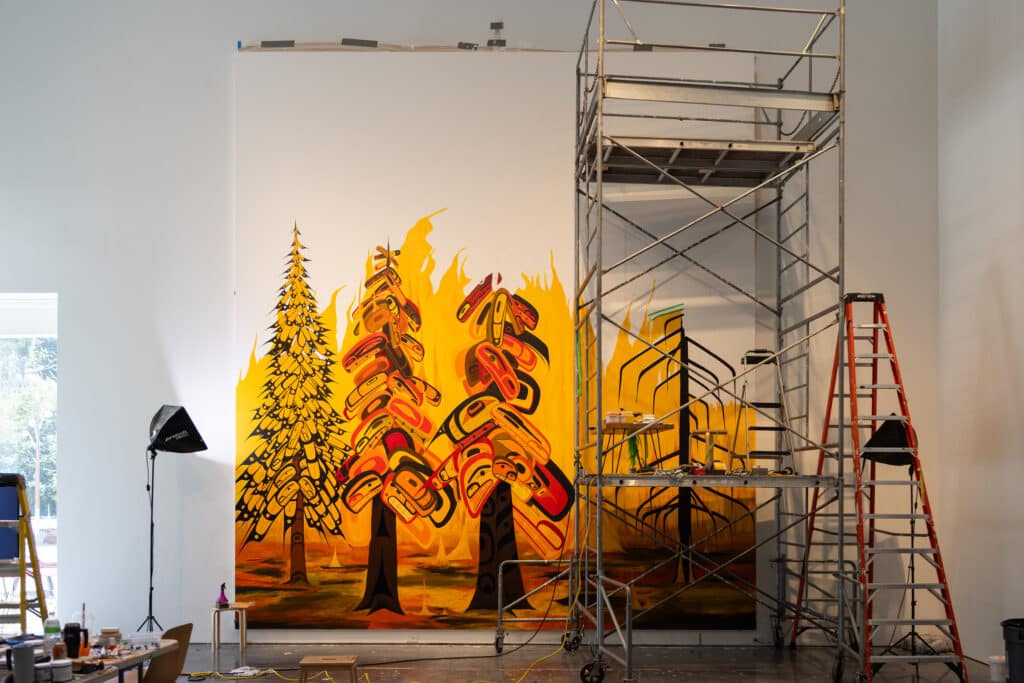
At 18 feet wide by 20 feet tall, the painting is Lawrence’s largest to date. It is also being executed “freestyle,” without a smaller-scale study, beginning with a drawing sketched directly onto the towering canvas. And nearly as vast as its dimensions is Lawrence’s understanding of how the work is located within the story of human culture.
Tens of thousands of years ago, people made paintings on cave walls, he says. They stencilled their hands or depicted animal hunts in iron oxides, charcoal and gypsum. Hundreds of years ago, Baroque painters marshalled the camera obscura to project the living world onto their blank canvases. In both cases, millennia apart and centuries distant from our own, people sought to represent the things they saw — to record their lives as they lived them.
“The world has to look at itself,” Lawrence says, gesturing to the partly finished painting on the wall, an impossibly large flame looming above a row of hard-edge trees, their ovoids and trigons rendered in black, brown, orange and yellow, all of them on fire.
“This is the world.”
He says the work is decidedly non-traditional, instead reflecting European conventions of scale and focus. Though he studied historical Coast Salish forms since childhood, he quickly realized his artistic preoccupations would be more clearly understood if he stepped outside those traditions.
“How do you carve global warming in a totem pole?” he asks. He suggests that images of human-made disaster are most appropriately rendered in the language of colonization — meaning pictorial forms rooted in European history.
“It’s an appropriation, but it goes beyond that,” he says. “It’s not a simple trick. And this is not easy. I’ve translated my culture into Western culture. But there is no salvation here.”
This incisive, unflinching gaze has earned Lawrence international acclaim, with recognitions including a VIVA Award, a fellowship at the Eiteljorg Museum of American Indians and Western Art and a 2019 Honorary Doctorate from ECU, from which he graduated with honours in 1983.
Most recently, he received both a Polygon First Nations Art Award of Distinction for his outstanding contribution to First Nations Art and the Gershon Iskowitz Prize, presented annually to an artist for outstanding contribution to the visual arts in Canada.
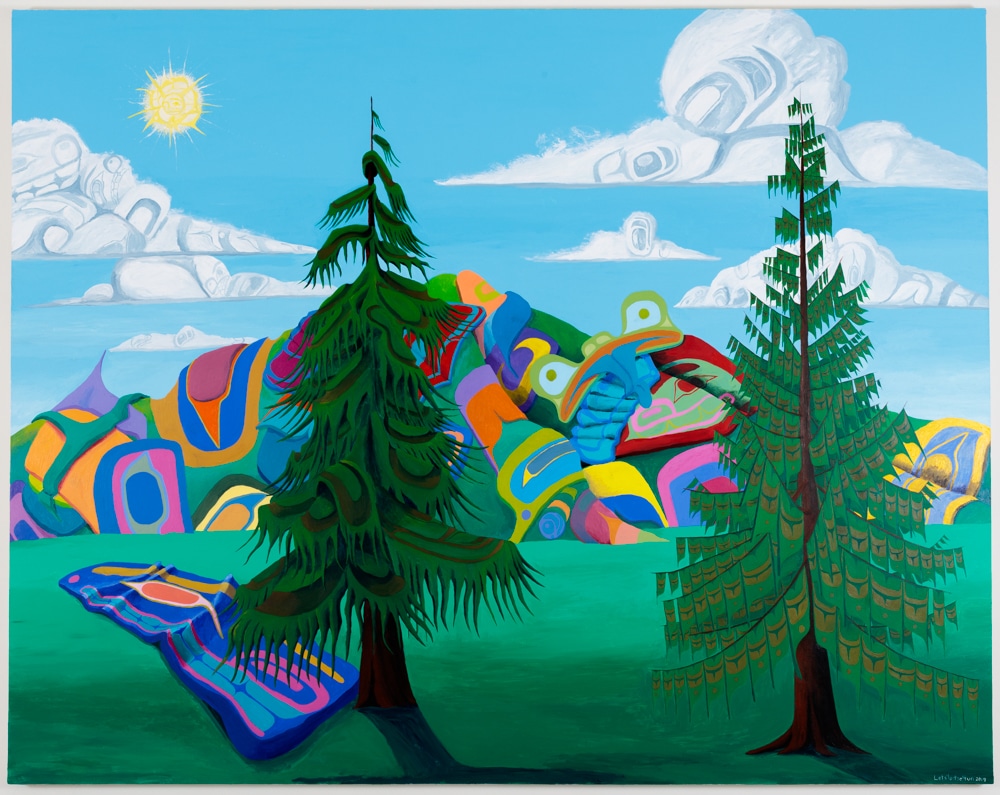
His work has appeared in solo and group exhibitions at major public galleries and museums across North America, Europe and Asia, not least a pair of landmark exhibitions at the National Gallery of Canada. His paintings are also held in numerous private and public collections across the globe.
His many acknowledgements, however, have not softened his focus in the least. Over a 40-year career, he has remained consistently committed to an unsparing critique of issues including environmental destruction, Indigenous land title and residential schools.
Yet his work also conveys a certain playfulness — a formal generosity that, according to many of the younger artists who know him, is as much a part of the man’s personhood as his paintings. Though he does not often speak about it himself, Lawrence is known for taking younger artists under his wing as assistants or informal mentees and has also reportedly delivered art supplies to emerging artists who are unable to afford them.
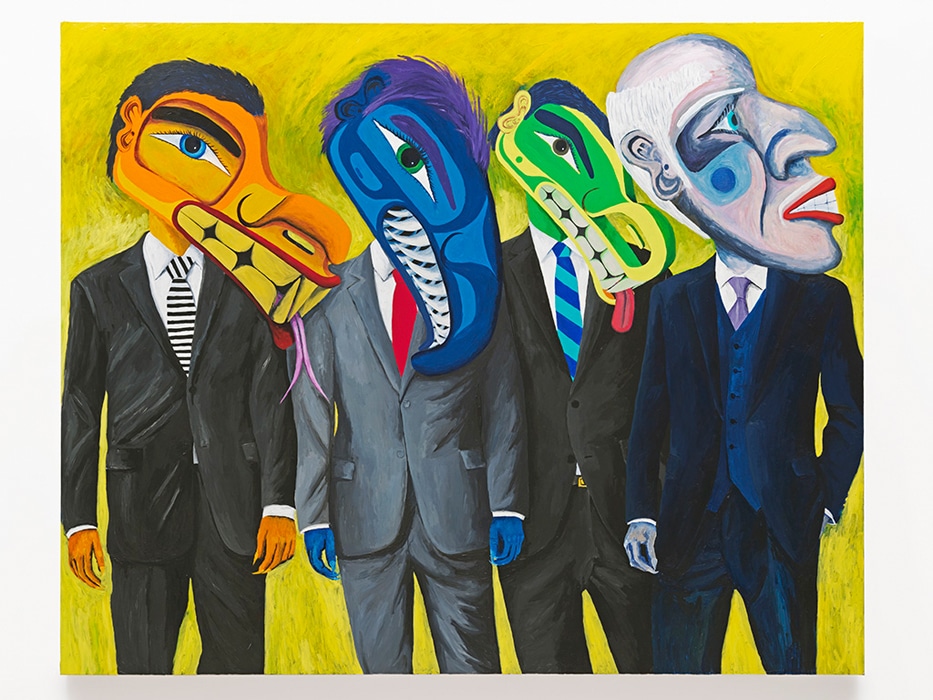
One is tempted to draw a line between these quiet kindnesses and his acknowledgment of his own teachers. In the years after graduation, Lawrence travelled to see many of the paintings he learned about in school. He points to Rembrandt as one of his favourites, but has visited works by Vermeer, Van Gogh, Goya, Matisse, and Monet; has seen the Impressionists at the Musée d’Orsay, the Dadaists at Kunsthaus Zürich, and The Garden of Earthly Delights at the Museo del Prado.
All of them provided inspiration, he says. Seeing them in person also revealed that the story they helped write was still being written. And Lawrence, true to form, was ready to speak.
“Emily Carr University taught me to look at the world,” he says. “And then I went to go see it. I looked at all these artists and I thought, ‘Okay. You guys had your best shot. You all had your turn. But everybody gets a kick at the can. Why not me?’”
Visit the Libby Leshgold Gallery’s website to learn more about Lawrence’s residency.