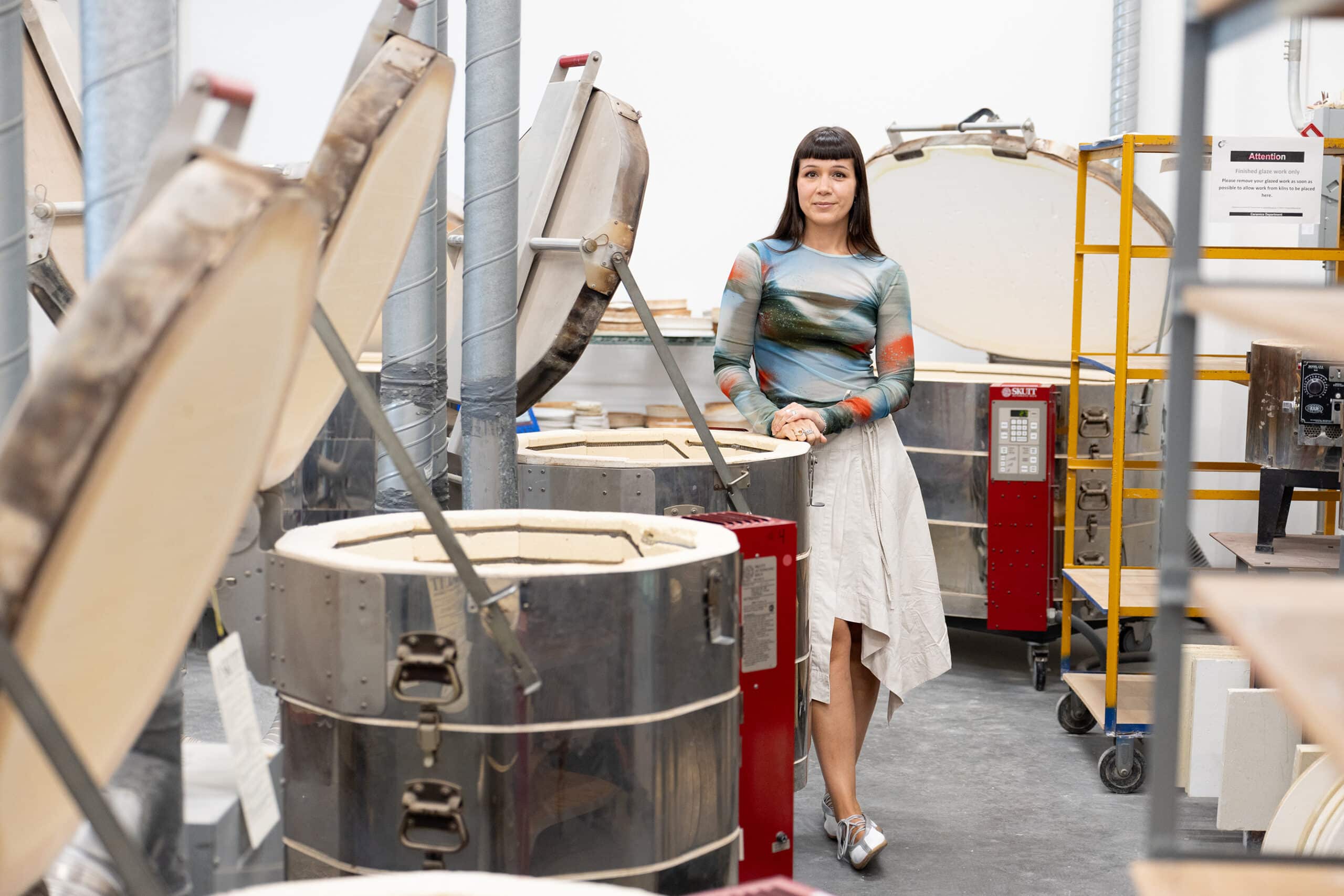
The artist, entrepreneur and newest staff member at the Aboriginal Gathering Place is showing up, showing respect and hoping to show you the transformative power of both.
People have coined aphorisms about it. Others have written poems. Some people make whole careers telling others how it works. The thing in question is opening yourself to the plan the universe has for you.
Doing so requires a certain amount of fearlessness. It also requires knowing yourself. Fortunately, artist Kimberly Ronning (BFA 2026) has both in abundance.
“I will just always try a thing. I’ll just do it,” she says, sitting in the Aboriginal Gathering Place (AGP) at Emily Carr University of Art + Design (ECU), where she was recently hired as Aboriginal Programs Coordinator. “I think that’s how opportunities come your way. You show up, you’re in the room and you say, ‘yes.’ Someone said once I was a keener and I thought, ‘You know what? I am. I’ll do it.’”
This steadfast gameness steered her from nursing to childcare and into a career in marketing, first as a freelancer for the parents of her young charges and eventually as a digital marketing manager with fashion retailer gravitypope. There, she led a team of creatives, designing campaigns including collaborations with esteemed artists, many of whom she remains close with today. Meanwhile, Kimberly was always squarely focused on making art.
She began photographing at age seven with encouragement from her father, also a photographer, who taught her to develop film in their hallway darkroom. These skills supported her work in marketing as well as several small businesses she created as an adult, including jewelry lines, children’s clothing and Danglers, an accessory brand now selling across North America and the U.K.
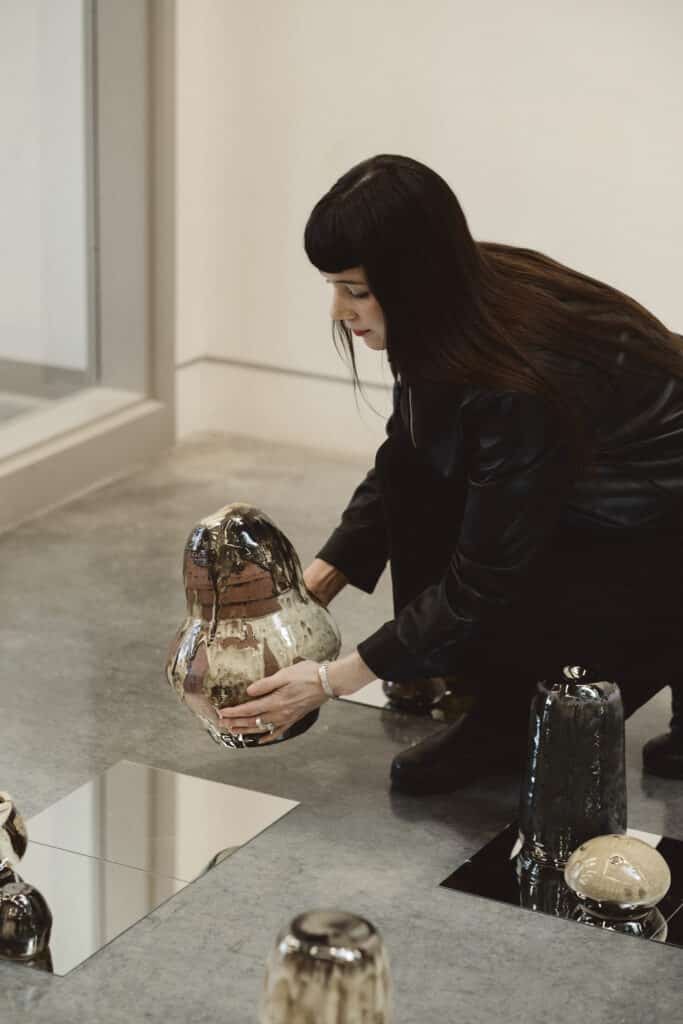
Kimberly was also fascinated by ceramics, mentoring for years under artist Nathalee Paolinelli (BFA 2004), whose work she often photographed in reciprocation for Nathalee’s guidance. That guidance included encouraging Kimberly to consider ECU to advance her expertise in the medium.
“I never even knew any of this was possible,” Kimberly says. “Even going to school was never my intention. And now working at the AGP, I realized I can apply so many skills and experiences to this job. Fifteen years of work in the fashion industry, my relationships with all these artists and business owners around the city, and my Bachelor of Fine Arts all elevate what I’m able to do here. Everything compliments each other. And I think not being attached to the outcome was a big part of that.”
Once at ECU, faculty member Julie York (BFA 1996) was a major influence as Kimberly developed a practice for which she was recently awarded a YVR Art Foundation Emerging Artist Scholarship. This practice currently comprises at least two distinct bodies of work, both exploring narration, materiality and identity through functional and sculptural forms. Kimberly, a member of Tk’emlúps te Secwépemc, says her most recent collections explore the capacity of objects to resonate with land, culture and story.
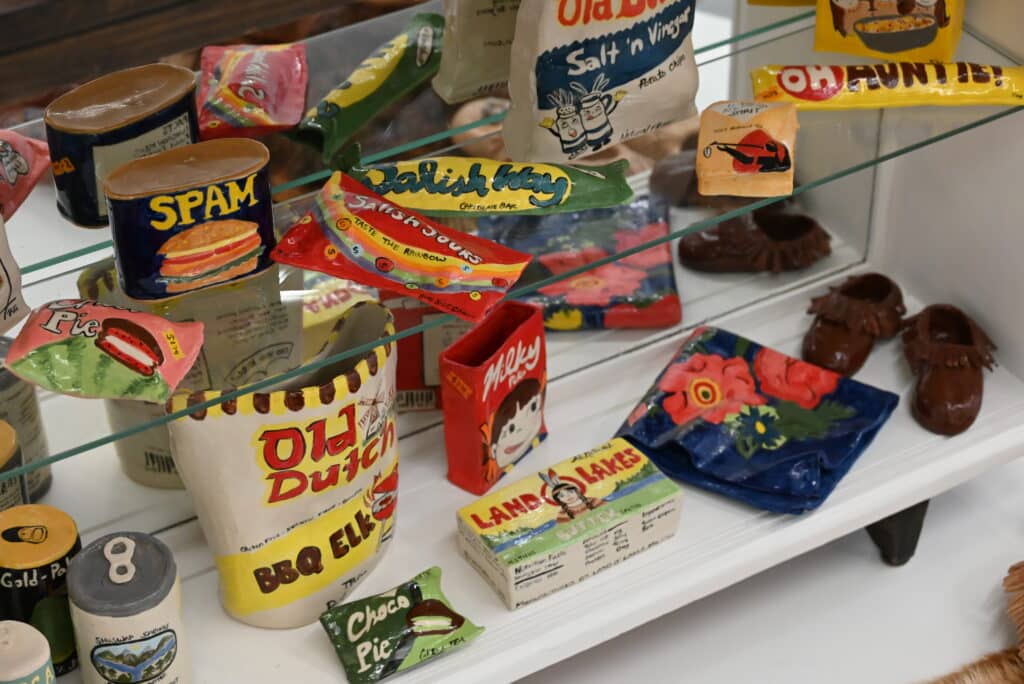
Urban Ndn reclaims the visual language of consumer products which have historically used Indigenous imagery, shifting their meaning through subtle edits in branding, characters and design. Kimberly describes their pop-culture familiarity as an invitation, noting their details contain a certain strangeness that reveals layered narratives about place, family and self-authored brands.
Meanwhile, a series of closed-form vessels — a technique she learned from artist Gloria Jue-Youn Han (BFA 2016) — delve more deeply into the ways material itself can hold meaning. Blending ceramics with moose hair, horsehair, beads and sinew, the vessels — some of which may be used as rattles — pursue a more poetic perspective on artmaking.
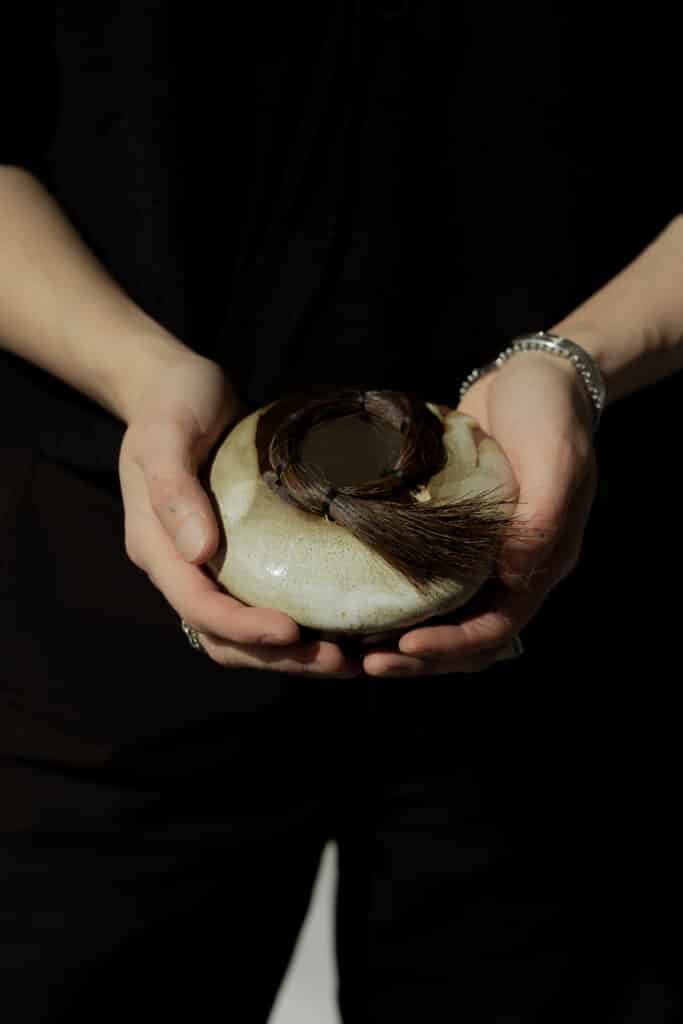
Kimberly notes this latter collection reflects many of the traditional practices she learned at the AGP as a student. The skills she developed through moose-hair tufting workshops with Kajola Morewood, Interim Director of Indigenous Programs, and drum-making workshops with Sydney Pascal (MFA 2023), Manager of Indigenous Programs, all found their way into the work.
“I was doing a lot of research to understand how ceramics could be traditional — which they’re not,” Kimberly says. “So, could traditional materials be replaced by ceramics? It was a big experiment, and I struggled with it. But now I have a collection that feels contemporary blended with the cultural learning I’d only ever learned through the AGP. So, it had a happy ending.”
Now at work on several new initiatives including online profiles of Indigenous ECU alums and students, a speaker series and plans for expanded workshops, Kimberly says her goal is to help make the AGP more accessible for students.
“A lot of people are intimidated to come in here,” she says. “And I get it, I was one of them. It took me nine months to walk through these doors for the first time. It’s a new space, it’s a small department, people seem to know each other already. But then you talk to Sydney and Kajola and they’re so nice and everyone is so welcoming. The AGP is a space for us as Indigenous people and we all need to be here. So, I want to make it seem like the easiest thing in the world to come and hang out.”
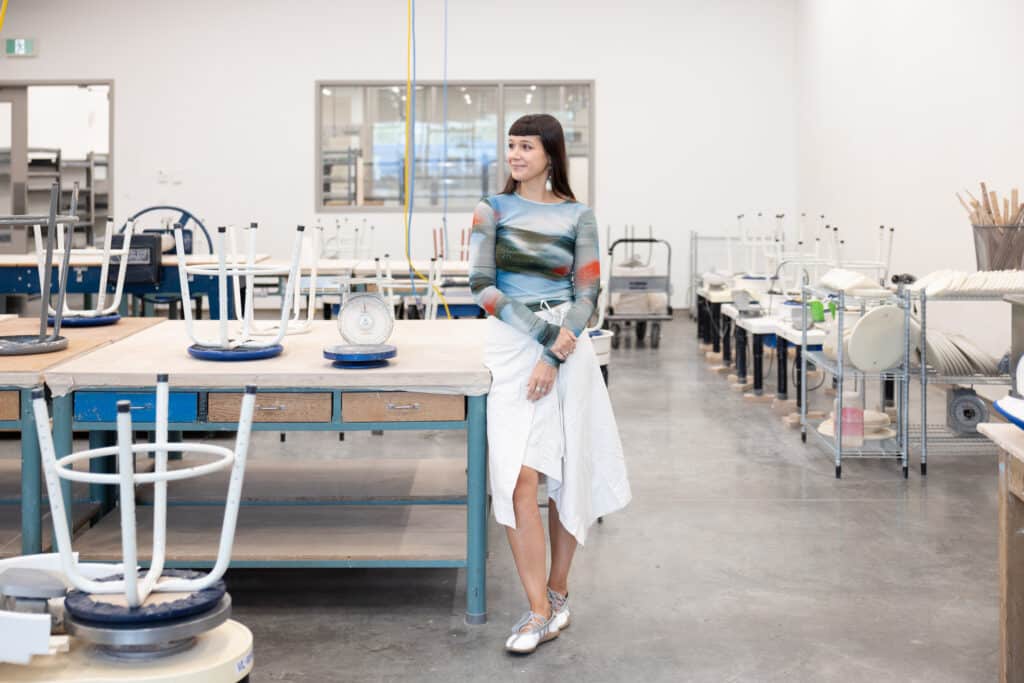
In part, this is because Kimberly so firmly believes in the importance of community. From her time in fashion and marketing to her decades of creative practice, the people around her have at every step been the lights that illuminated her path. Her job, as she sees it, has been to embrace what those lights have shown her. This is a lesson she hopes to pass on to the emerging artists and designers with whom she now works.
“Especially since I said yes to school, every door has opened. Everything has been ‘yes,’” she says. “Because of ECU, I got to travel; I’ve been to New York, Seattle, Santa Fe. I found all these great opportunities; I made beautiful friendships; and now I have this job I’m so excited about.
“And of course, you need to show up, listen, follow through, be respectful. Those things matter. But everything starts to make sense when you make the right choices. Everything is so connected. We’re all so connected. And as soon as one thing’s right, 10 things are right.”
More about Ceramics at ECU
Set within the Visual Arts Major at ECU, the Ceramics curriculum covers wheel throwing, hand building and
mold making.
Explore digital applications like 3D printing, merging classical methods with innovative technology and experimenting across related art forms, including sculpture and design, to gain a clear understanding of ceramics’ role in contemporary art and design worlds.
Visit ECU’s website to learn more.
More About Aboriginal Programs at ECU
The Aboriginal Program Office provides culturally appropriate support that encompasses both traditional and contemporary artistic and cultural expressions of Aboriginal peoples, and is a valuable resource for students to access traditional materials/supplies.
The Aboriginal Program team also assists with the promotion and coordination of events and workshops related to Aboriginal art and culture, and is responsible for providing information regarding Aboriginal funding, scholarships and awards.
Visit the Aboriginal Gathering Place online to learn more about their programming and resources.
100 Years of Creativity: The Stories that Shaped Us
As part of Emily Carr University’s centennial celebrations and our ‘100 Years of Creativity’ campaign, we are sharing stories that spotlight the creativity, resilience and impact of our community over the past 100 years. These stories feature the people, projects, places and ideas that have shaped ECU, reminding us of our shared legacy while inspiring the future. By revisiting past milestones and sharing new ones, we honour the many voices that built our institution and continue to guide its path forward.
For more information about ECU 100 centennial celebrations, upcoming events and stories, visit our webpage.
Want more stories like this one delivered twice a month to your inbox?
Subscribe to our FREE Emix newsletter today!