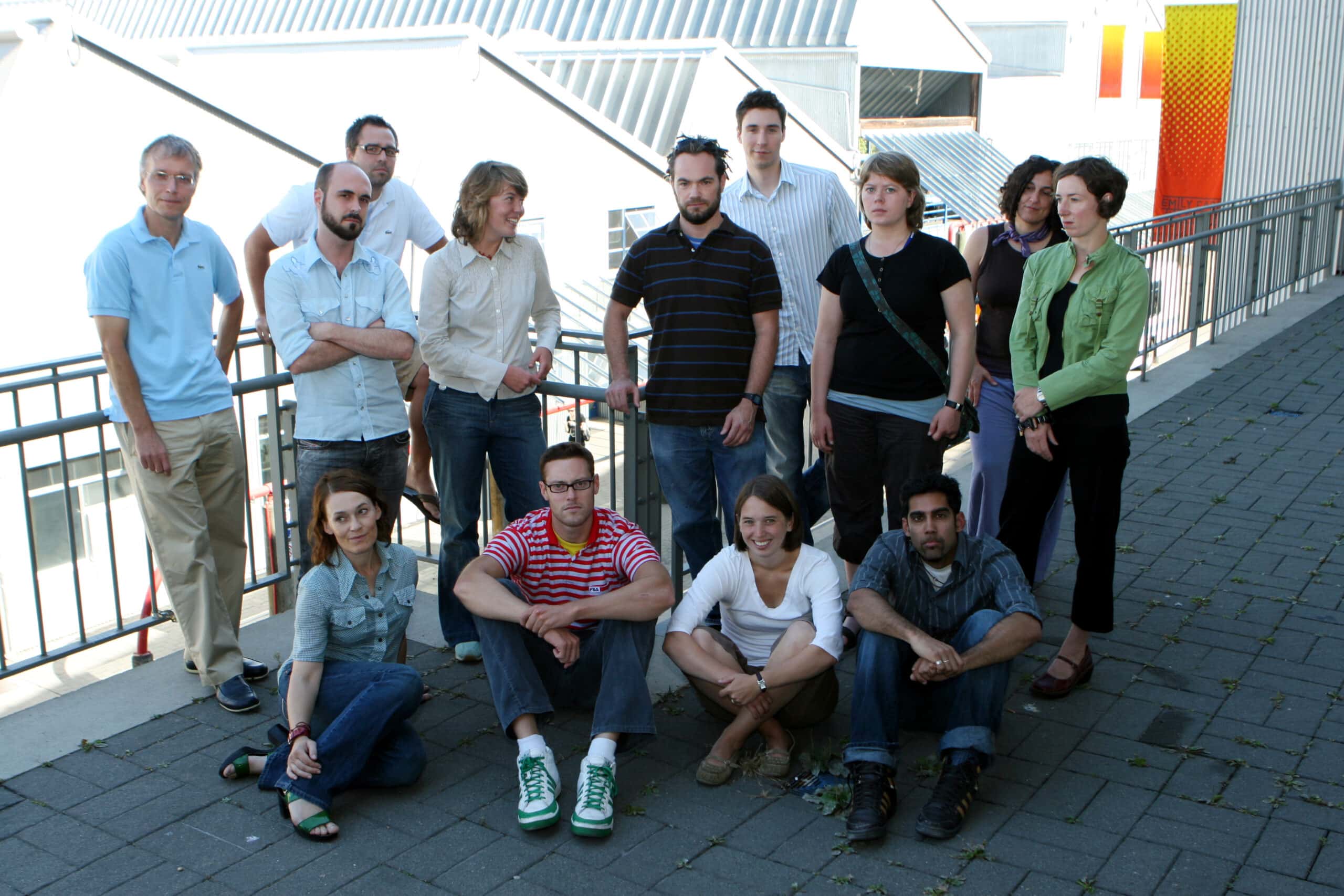
Alums and faculty members look back at Graduate Studies’ history and evolution as the university turns its eyes to the future.
While ECU is set to wind down its year of centennial celebrations this fall, the university continues to look forward to new milestones. Among them is the 20th anniversary of Graduate Studies at ECU, which welcomed its first cohort to campus in 2006.
“ECU offers some of the world’s best graduate programs in art and design, and a big part of that success comes from preparing our students to excel in the next stage of their careers, creative practices, and academic journeys” said Justin Langlois, Associate Vice-President of Research + Dean of the Jake Kerr Faculty of Graduate Studies. “When you look back at the last 20 years, there have been so many incredible artists, designers, and scholars who have completed their master’s program at ECU and gone on to make substantial impacts in their fields and in their communities.”
Beginning with a Master of Applied Arts (MAA) in 2006, ECU’s Graduate programs would expand to offer standalone Master of Design (MDes) and Master of Fine Arts (MFA) pathways in 2013. In 2015, the faculty was renamed the Jake Kerr Faculty of Graduate Studies for the business executive, philanthropist and keystone donor.
In 2010, ECU launched its Low-Residency MFA, offering a flexible structure for working artists, creative practitioners and educators. And in 2025, ECU debuted its Critical Ecological Practices Low-Residency MFA, a program specifically designed for creative practitioners exploring ecological topics through research-driven art. This same year, ECU opened its new 10,000-square-foot Graduate Student studios in the Centre for Digital Media, across the street from the main campus.
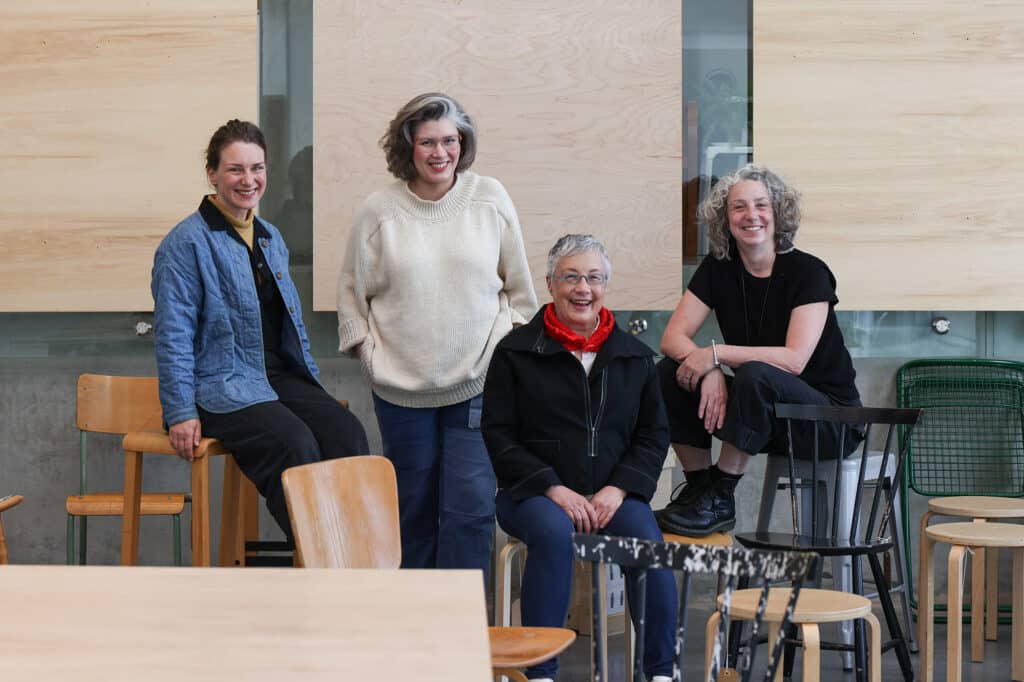
Designer and ECU faculty member Hélène Day Fraser (MAA 2008) was part of the inaugural Graduate Studies cohort which brought together artists, media practitioners and designers.
After graduation, Hélène began teaching at ECU and, with faculty member Keith Doyle, co-founded the Material Matters Research Commons, a set of interdisciplinary design and art research labs at the heart of innovation at ECU. Through their work as well as through projects with partners throughout the university, across the country and internationally, research-creation has become a pillar of the ways ECU faculty, staff and students mobilize creative practices to transform the world — a state of affairs that Hélène says was seeded in large part by those early days of the Graduate Studies program.
“The master’s program centred the question of ‘what is research,’ which helped facilitate all these new ways of collaborating and thinking about practice that wouldn’t have happened before — it fostered all sorts of new spaces,” she says. “So, the most amazing thing about the master’s program was how it allowed me to rethink what I was doing drastically. I think it still does that for people, over and over again. It opens completely new possibilities.”
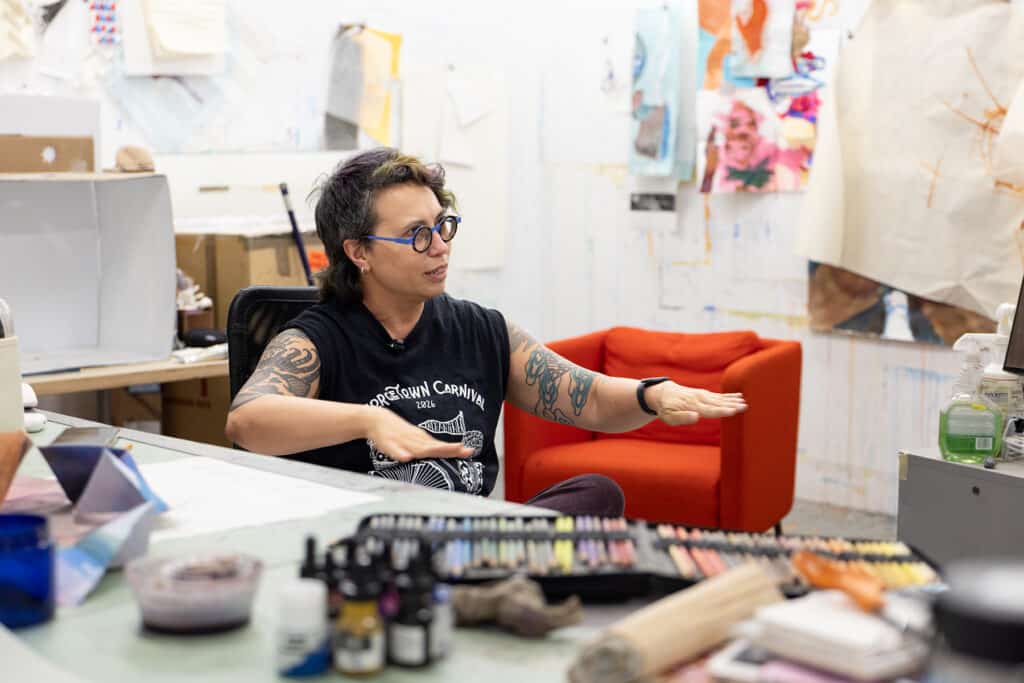
Diyan Achjadi, ECU’s Vice-President Academic + Provost, had recently begun teaching at ECU in 2006. Having taught previously at universities with Graduate programs, Diyan was one of three ECU instructors tapped to lead the new MAA program, whose inaugural cohort included Hélène.
Echoing Hélène, Diyan says today’s ECU is rooted in the concerns and curiosities that animated that initial launch.
“So much of the approach to work here is about collaborative, speculative, expansive thinking, as well as foregrounding important conversations, such as Indigenous worldviews and ecological awareness,” Diyan says.
“We have faculty doing vitally important research projects that involve grad students as well as undergraduates as research assistants, which expands into curriculum in a multiplicity of ways. I see all these things, which are now so deeply embedded, as emerging from that 20-year arc.”
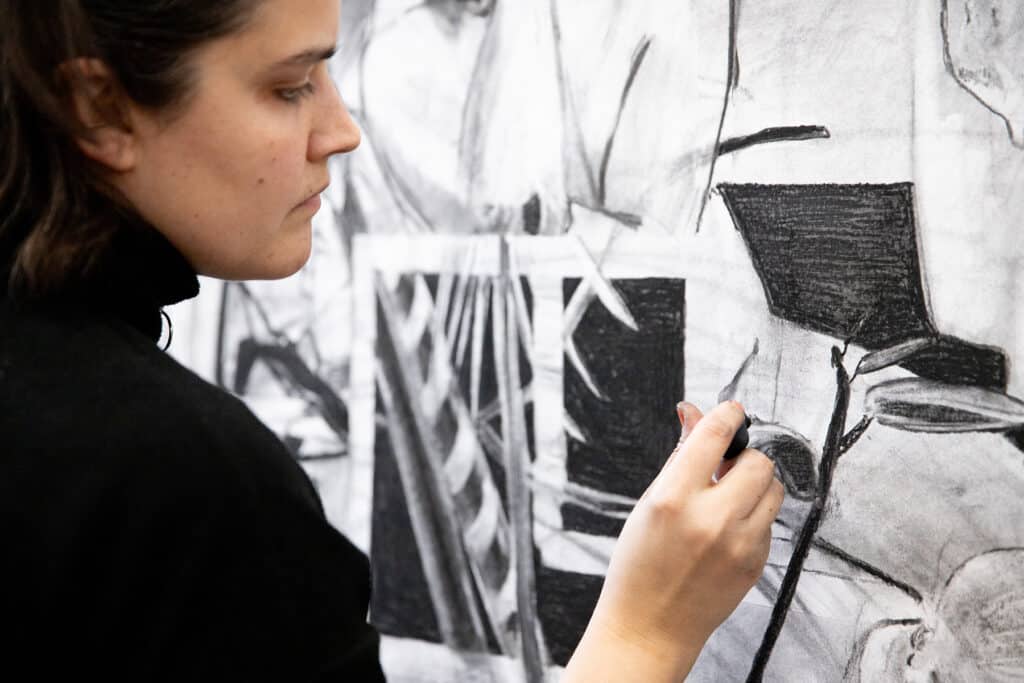
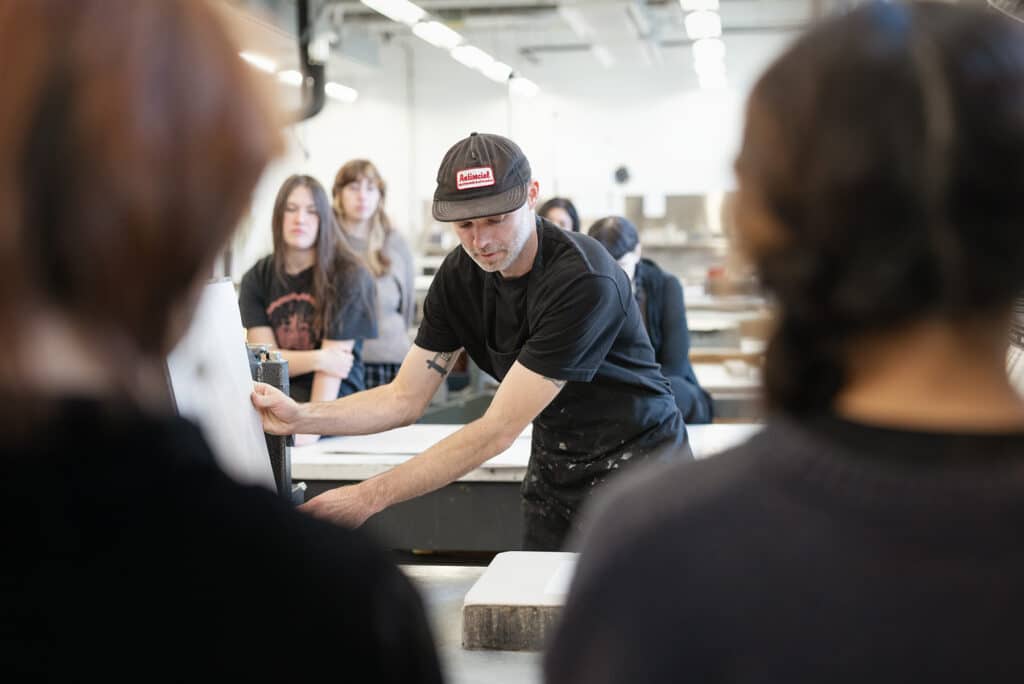
Sara-Jeanne Bourget (MFA 2019) and Mark Johnsen (MFA 2020) overlapped for a year in ECU’s Full-Residency Master of Fine Arts program, during which time they became a couple. Now both faculty members at ECU and proud parents of two small children, they say their connection was both unexpected and vital, having moved from Quebec and California, respectively, for their studies.
“We had the school as an anchor,” Mark says. “When you go to an opening, when you go to a show, there’s Emily Carr people. They’re everywhere. That was very helpful as a new person to the city.”
The pair say they maintain close connections with artists working at ECU as well as throughout the country and beyond, though their connection with each other is exemplary of how relationships have nourished and sustained their careers as artists and educators.
“Before we met, I was solely drawing. Mark reintroduced me to printmaking, and my practice has been fully split since then. He showed me a new way of thinking about my work, and that was wonderful,” Sara-Jeanne says. “We made real, lasting relationships, and I’m very thankful for that.”
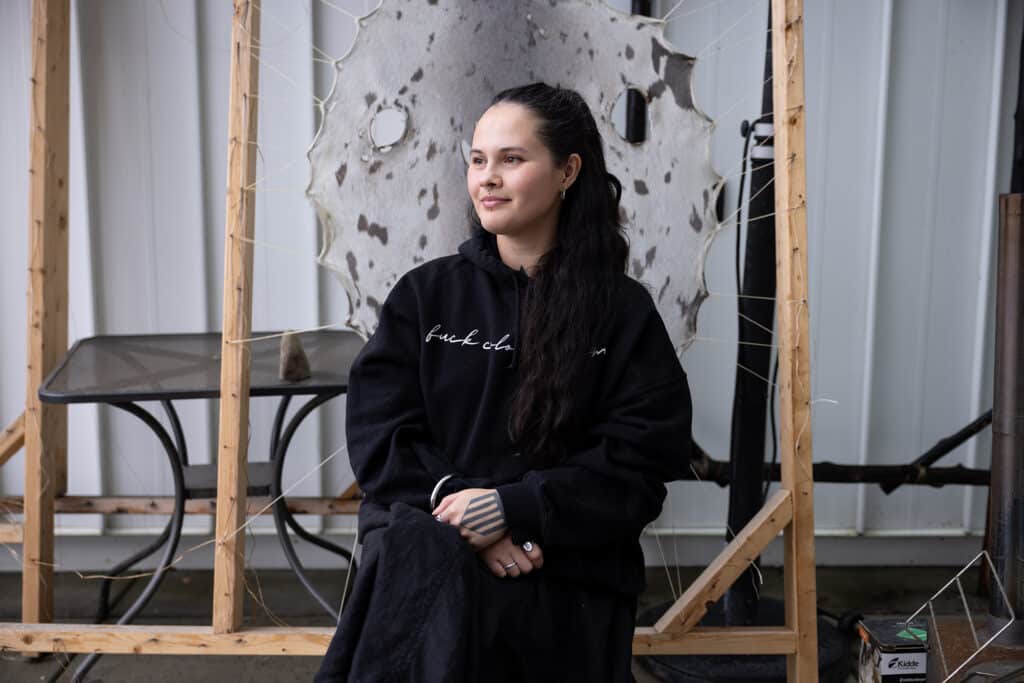
Sydney Pascal (MFA 2023) studied in the Low-Residency Master of Fine Arts program while maintaining a full-time position as Aboriginal Programs Coordinator at ECU. Now the Manager of Aboriginal Programs, Sydney says the program’s structure, which combines online coursework with immersive summer residencies, meant her cohort included students living across the globe.
Sydney says the program provided support, including mentorship, time and resources to facilitate experimentation and focused development. As a result, Sydney graduated having produced a pair of films which have since been shown internationally, including at the Whitney Biennial and Vancouver Art Gallery.
“I had the freedom to explore with no barriers; there was space to focus on my ideas without deviation,” she says. “It was very much a steppingstone to my work going out in the world.”
More about Graduate Programs at ECU
In ECU’s Master of Fine Art (MFA) and Master of Design (MDes) graduate degree programs, students engage in hands-on studio practice and critical inquiry, participate in one-on-one and group critiques, and regularly receive feedback from teaching faculty, peers and visiting professionals.
With access to individual and communal studio spots, as well as reservable hot-desk studios, students make, experiment and foster connections in a space exclusive for world-class graduate-level work.
Learn more on ECU’s website.
Want more stories like this one delivered twice a month to your inbox?
Subscribe to our free Emix newsletter today!