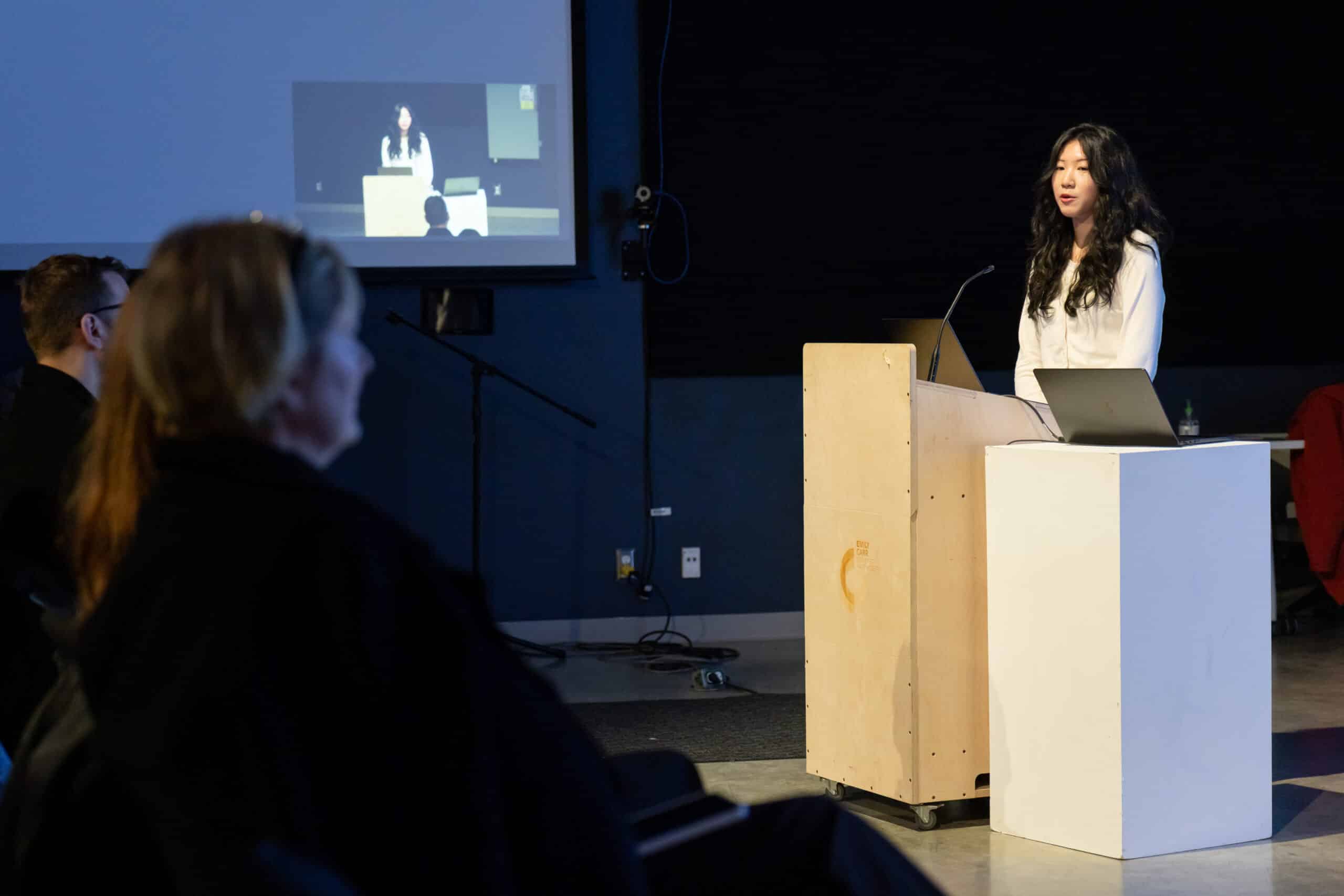
Led by product leader and entrepreneur Ryan Smith, ‘Creating a Design Startup’ saw students create meaningful, market-ready products from the ground up for presentation to local industry.
A recent Interaction Design course at Emily Carr University of Art + Design (ECU) challenged students to develop an app alongside a viable business plan for presentation to industry professionals from across the Lower Mainland.
Fourth-year student Shirley Zhao says the 12-week course provided a comprehensive introduction to entrepreneurship as well as a transformative context for how design skills can be mobilized to build a business.
“This class was definitely a game changer,” she says. “We prepared business reports and go-to market strategies, operational plans, validation, research, and we showcased all of it in front of real industry representatives. I also gained a much better understanding of how a startup would work from an entrepreneurial perspective. As a designer, I feel like I now have a huge advantage in terms of standing out as a potential employee.”
The course, called ‘Creating a Design Startup,’ was developed by designer and ECU faculty member Haig Armen in partnership with the Shumka Centre for Creative Entrepreneurship. The fall 2025 edition was taught by Ryan Smith, CEO and Product Lead of Smith Horn Group, who gathered tech and design leaders from across Metro Vancouver for the students’ final presentation. Guests included staff and executives from companies such as Metalab, Jobber, Creative Destruction Lab and the Mark Anthony Group.
‘Creating a Design Startup’ is part of Shumka Centre for Creative Entrepreneurship’s Pathways for Creative Futures program, delivered in partnership with the Business + Higher Education Roundtable, and with support from the Government of Canada

SUGAR IN THE KOOL-AID
Ryan says he designed the course to equip students with practical skills for building a tech startup from scratch. Instead of having students focus on their expertise as interaction designers, he tasked them with learning how to locate that expertise within the full scope of commitments and aptitudes required to launch a business.
“Rather than framing this course like other startup accelerator-type programs, which are about the pitch and the raise and valuation for your world-changing ideas, I got more pragmatic,” he says.
“So, a person has an idea they’re passionate about, but how much will it cost to make? What price are people willing to pay for it? Are you going to break even? Will you be able to operate sustainably? I tried to reduce the sugar in the Kool-Aid because there’s a lot of that in the startup world.”
T-SHAPED PRACTICE
Ryan notes his course was, in part, aimed at turning his students into “T-shaped” designers. The concept refers to honing both specific, deep expertise (the vertical part of the “T”) and an ability to work across functions (the horizontal part of the “T”).
A T-shaped skillset helps ensure professional resilience in a rapidly evolving industry, he says.
“2025 is going to go down as a big inflection point for how we work, especially for knowledge workers,” he says, noting industry is increasingly adopting artificial intelligence (AI) tools to automate many routine tasks in addition to requiring broad collaboration across specialized departments.
“I see senior people in this industry consistently saying the most important skill to learn is workflow — so, how to stitch together different tools and assets in sequence rather than becoming a single-tool specialist. And we are delivering that type of training to students through this project of creating a design startup so they can have more confidence in their ability to stay competitive in that environment.”

CHEAT CODE
Marie Gosal, Executive Design Director at product design agency Metalab, attended the students’ final presentation as an industry guest. Marie attests to the rapid transformation of her industry, noting that her own team hires for T-shaped designers — a quality which typically develops over time through work experience.
“I was struck by the breadth of what students covered in this course,” she says. “It’s almost like a cheat code for interaction design students to learn things like unit economics and marketing acquisition costs. It’s priming them for the workforce. They’re going to be more engaged and grow more quickly, even simply by possessing a baseline vocabulary for understanding concepts like profit and loss or budget.”
Marie was likewise impressed that students were permitted to use AI to develop their apps, so long as they cited their work. Familiarity with such tools is increasingly becoming a professional necessity, she says. Seeing students learning how and when to use them felt like a win for an industry looking to hire for such skills.

HUMAN DECISIONS
Fourth-year student Amy Ma calls the course “intense,” adding that the entire class keenly felt the steep learning curve in the early weeks.
But by the end, Amy says she felt far more confident in her abilities and in her understanding of the tools and expectations she’ll encounter post-graduation.
“This course helped me understand how designers fit into production workflows,” she says. “We also learned a lot about AI — like how it may not be appropriate or even useful for creative work but can help accelerate administrative tasks like market research, validating findings, organizing notes and transcribing speech. But interaction design is ultimately about humans. So, humans need to make design decisions because we know each other best.”
More About Interaction Design at ECU
Interactivity is everywhere—from apps and websites to physical devices, games and service systems. You’ll gain hands-on experience designing digital and tangible media through sketching, prototyping and testing.
ECU’s interdisciplinary Interaction Design program blends technical skills, critical inquiry and human-centred research while allowing you to take courses in Communication Design, Industrial Design, Animation and New Media + Sound Art.
Led by expert practitioners, this program prepares you to navigate the evolving fields of UX, interaction design and emerging technologies.
Visit our website to learn more.
More About Shumka Centre for Creative Entrepreneurship
Shumka Centre is a place where creative practitioners can find the community, knowledge, and resources they need to launch, fund, and organize projects across the spectrum of contemporary art and design activities – products, projects, curatorial initiatives, platforms, companies, organizations, and more. By offering tactical support tailored to the unique needs of artists and designers, the Shumka Centre strives to foster systemic change and amplify creative potential.
Visit their website to learn more.
Want more stories like this one delivered twice a month to your inbox?
Subscribe to our FREE Emix newsletter today!