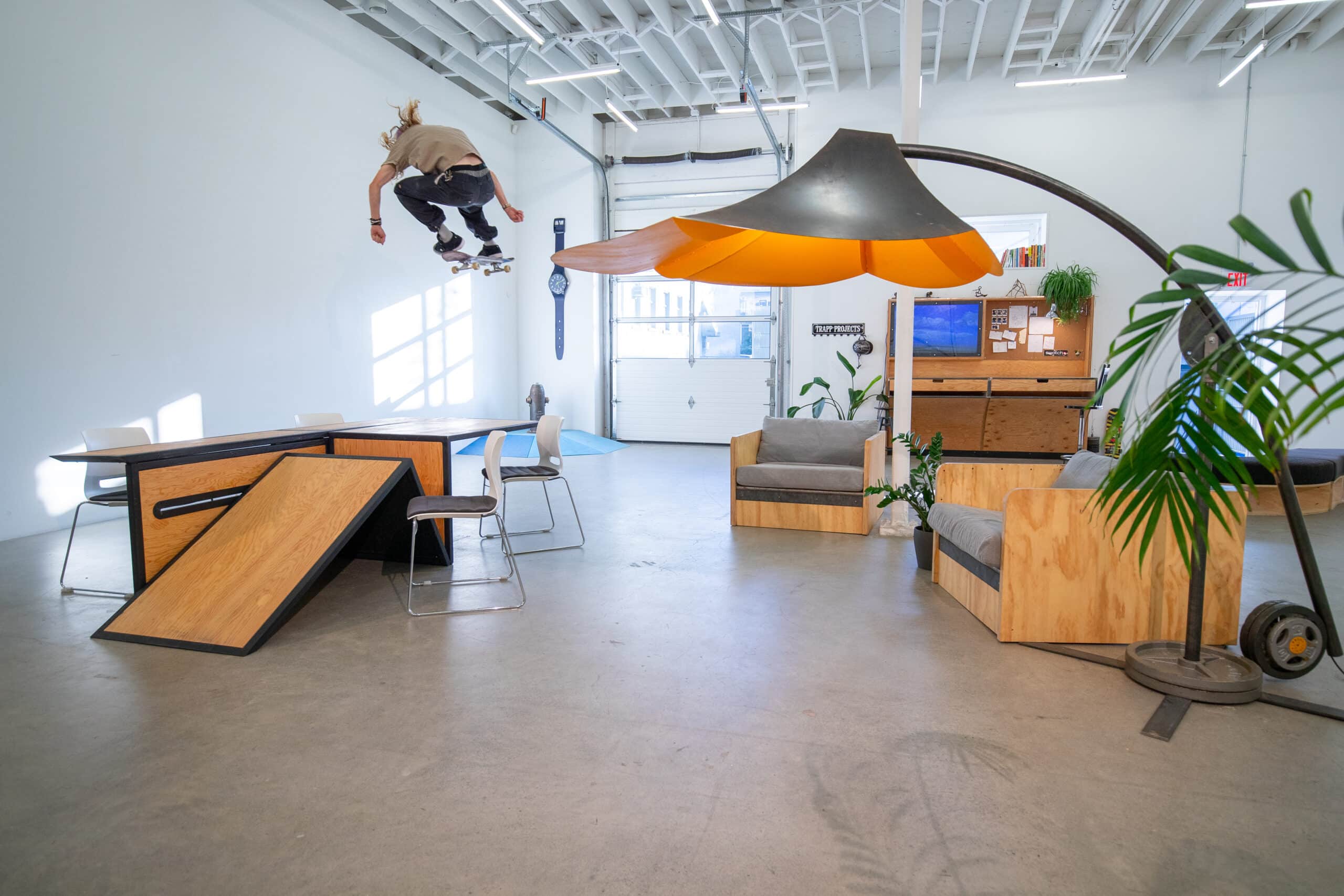
Featuring artists Andy Anderson, Benny Zenga and Christian Zenga, ‘Skate Break’ shows how play can “free the mind and invigorate the body.”
A series of “skateable” furniture items are among the show-stopping artworks in a new exhibition by ECU faculty member Patrik Andersson’s independent curatorial platform, Trapp Projects.
Featuring work by artists Christian Zenga (BFA 2018), Benny Zenga and Andy Anderson, Skate Break showcases “experiments that shuttle between art, design and athletics.”
“Like [their] Surrealist predecessors, we see an impulse towards non-productive play,” Patrik writes in his curatorial essay. “The forms they have designed follow very specific functions, yet the result is extraordinary.”
Each artist is actively involved in specialized disciplinary practices outside of artmaking. These influences complicate and enrich their work as artists. Andy is a world-renowned skateboarder who represented Canada at the 2020 Olympics. He also designs skateboards, wheels and graphics. Christian, meanwhile, is an architect, while his brother Benny is a filmmaker. The drawings, film and print in Skate Break underscore the artists’ “prying open” of “new hybrid cultural models.”
The Zenga Brothers’ custom-built furniture pieces embody “the spirit of spontaneous play.” A simple button or lever conjures “dreamlike skate spots” from within the mundane form of a commonplace object.
A lamp becomes a volcano ramp and rail. Somewhere within two lounge chairs lurks a quarter pipe, a hip, a spine or a jump ramp. A camper van morphs into a mini ramp, wall ride or box jump.
But these transformations are not merely physical, the Zenga Brothers suggest. They hold the potential for existential renewal.
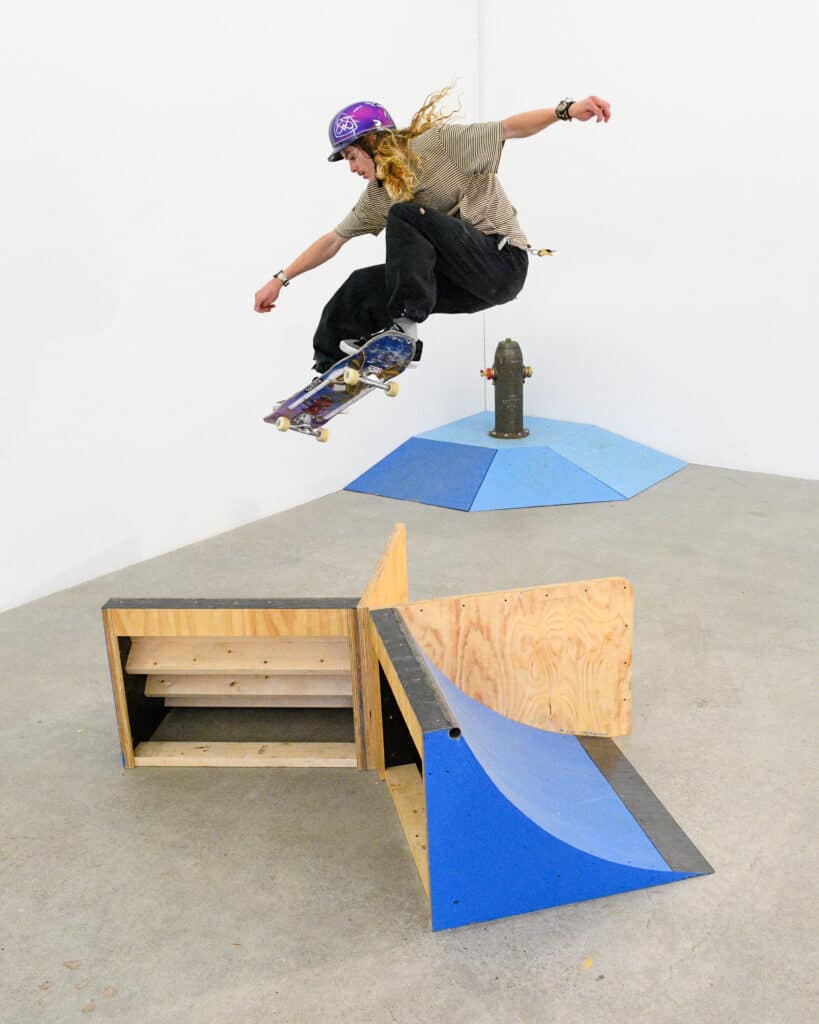
“These dream builds are sculptural, skateable objects,” the brothers write. “Whether at home, in the office, out on the street or in an art gallery, any space is transformed by these multi-configuration rejuvenation stations. Why Skate Break? To free the mind and invigorate the body. To excite the modern workspace and transform the world.”
These tenets, Patrik adds, are precisely the power that play brings to the everyday.
“Most of today’s working class sit in front of computer screens fulfilling administrative tasks or doing online communication at the expense of the body,” he writes. “What the worker of today needs, it could be argued, is a mental break combined with physical movement. This, you could say, is where skateboarding rethinks the ‘bored’ room with the help of transforming desks, sofas, lamps, and other designed artworks.”
Skate Break is on view Saturdays and Sundays from 1 to 5 P.M. through Feb. 18, 2024. Viewings are also available by appointment. Trapp Projects is located at 274 East 1st Avenue in Vancouver. Access is through the back alley entrance.
Visit Trapp Projects’ website and follow them on Instagram to keep up with their outstanding curatorial programming.
More About Curatorial Practices at ECU
ECU’s Curatorial Practices minor equips you with the tools to research, plan and present exhibitions that shape how art is experienced.
Through coursework and projects, you’ll learn to write proposals, plan exhibitions and explore how curatorial choices influence meaning, dialogue and public engagement with art. You’ll explore self-curation and peer curation, understanding how curatorial strategies influence artistic presentation.
Internship opportunities and external collaborations may further enhance your learning, preparing you to integrate curation into your artistic or design career.
Visit ECU’s website to learn more.
Want more stories like this one delivered twice a month to your inbox?
Subscribe to our free Emix newsletter today!