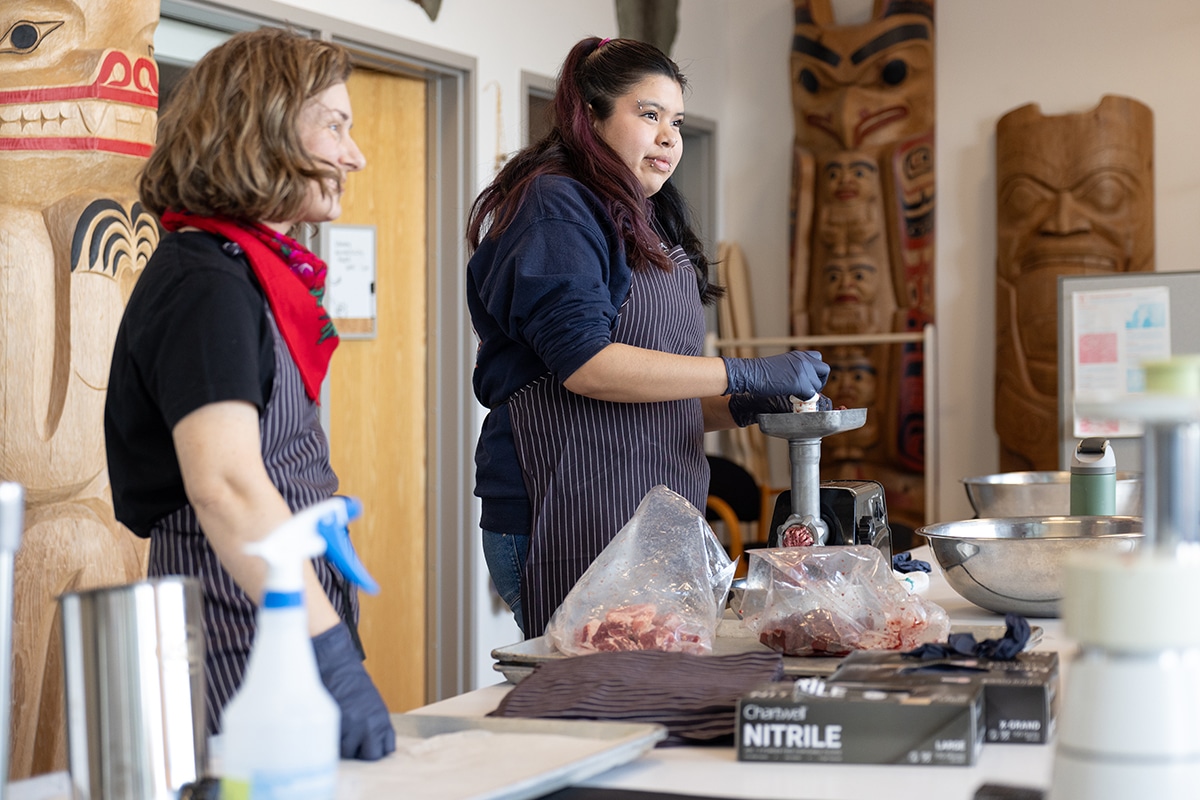
Led by chefs from the Vancouver Aboriginal Friendship Centre Society, the workshop forms part of Sharing Foodways, a SSHRC-funded research project focused on community kitchens.
A recent food-making workshop launched a programming series aimed at developing food sovereignty, food independence and culturally resonant nutrition.
Held at the Aboriginal Gathering Place (AGP) at Emily Carr University of Art + Design (ECU), the workshop taught students and faculty the art of making sausages from scratch.
“A lot of our Indigenous students are away from home, which can mean they may not have access to traditional foods or are missing out on learning traditional ways of working with food. Other students never had access to those traditions or foods in the first place,” says Daina Warren, Executive Director of Indigenous Initiatives at ECU.
“We want AGP to be a space of learning for the broadest possible spectrum of Indigenous practices. We also maintain a pantry here so that students have sustenance throughout their studies. This workshop is a way of expanding our capacity to offer both access to traditional learning and options for healthy, culturally specific nutrition.”
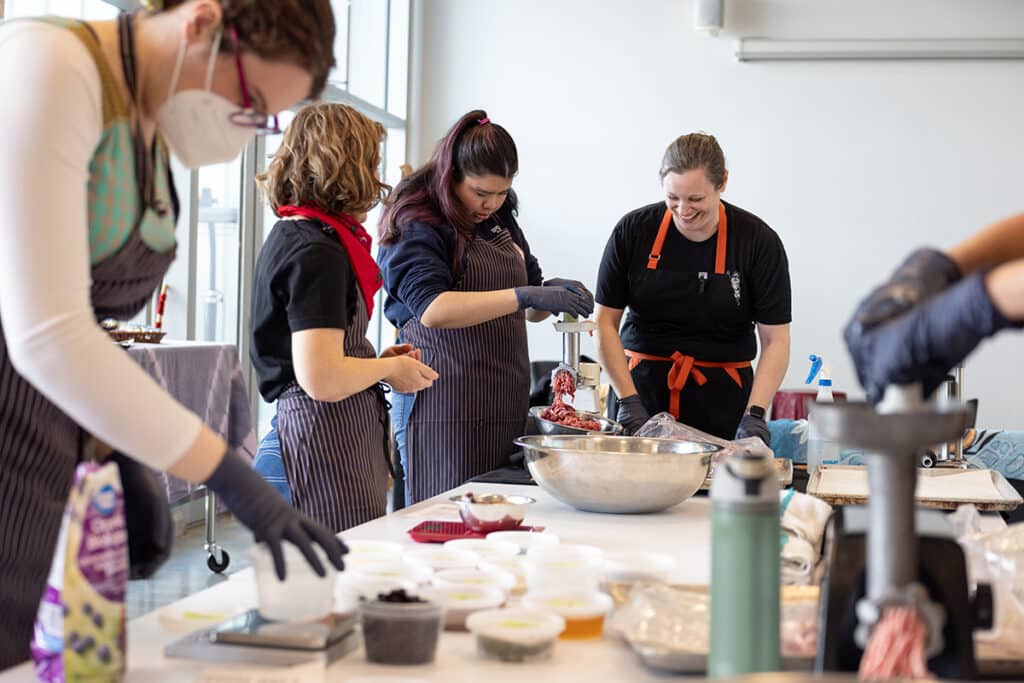
The workshop is part of a research project called Sharing Foodways: Prototyping Tableware for Commensality, funded by a Social Sciences and Humanities Research Council Institutional Grant. Sharing Foodways is led by ECU faculty member Laura Kozak with fellow faculty members Morgan Martino and Dr. Amanda White, and six student research assistants.
The project explores what kinds of cultural exchange, interdisciplinary dialogue and relational learning might emerge when artists and designers reimagine ways to support community kitchens. The project responds to Daina’s vision for the AGP; specifically, understanding how different food-learning practices might support cultural food literacy.
The AGP workshop was led by Heat Laliberte, Head Chef at the Vancouver Aboriginal Friendship Centre Society (VABCS), and Adriana Purdie, VABCS’s Sous Chef. The pair taught their group to make a chorizo-style sausage with elk venison and a bison-and-blueberry sausage. Participants learned about spices, processing meat, how to prepare casings, and how to assemble a finished sausage.
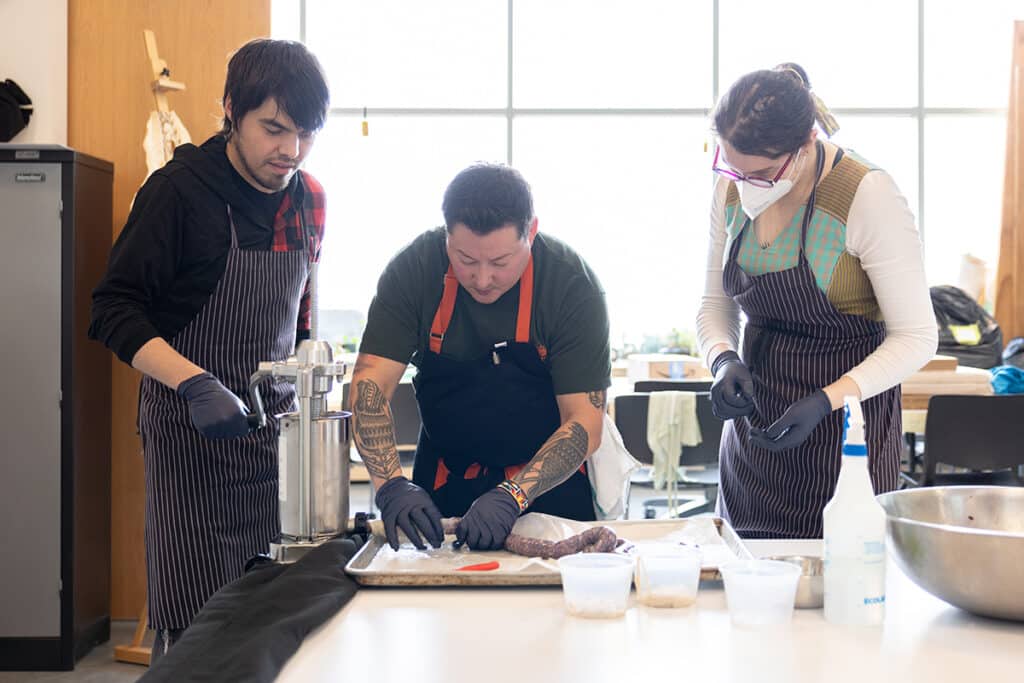
Heat noted that, for thousands of years, bison were a staple food and material resource for many Indigenous cultures. But in the late 1800s, colonial governments, including the Government of Canada, aided or facilitated the systematic extermination of the animal as a tool of colonization, forcing First Nations onto reserves, restricting their independence and clearing land for railway development and European settlement.
But recent decades have seen a resurgence of bison farming, particularly in Western Canada. Heat says learning to cook with its meat is a way of reengaging with Indigenous traditions as well as developing vital skills for personal independence.
Daina and Laura hope to bring a similar approach to food learning to a range of future workshops at the AGP, including growing and canning food, and working with Elders to foster the vitality of traditional knowledge.
Visit the AGP’s website and follow them on Instagram to learn more about upcoming events.
More About Aboriginal Programs at ECU
The Aboriginal Program Office provides culturally appropriate support that encompasses both traditional and contemporary artistic and cultural expressions of Aboriginal peoples, and is a valuable resource for students to access traditional materials/supplies.
The Aboriginal Program team also assists with the promotion and coordination of events and workshops related to Aboriginal art and culture, and is responsible for providing information regarding Aboriginal funding, scholarships and awards.
Visit the Aboriginal Gathering Place online to learn more about their programming and resources.
More about Research at ECU
As one of the most research-intensive art and design universities in Canada, ECU connects art, media, and design practices with some of the most pressing questions of our time. At ECU, we believe our research can help to transform the world, build healthier and more vibrant futures, and cultivate cultural resilience throughout our local and global communities and industry partners.
Visit our website to learn more.
Want more stories like this one delivered twice a month to your inbox?
Subscribe to our FREE Emix newsletter today!