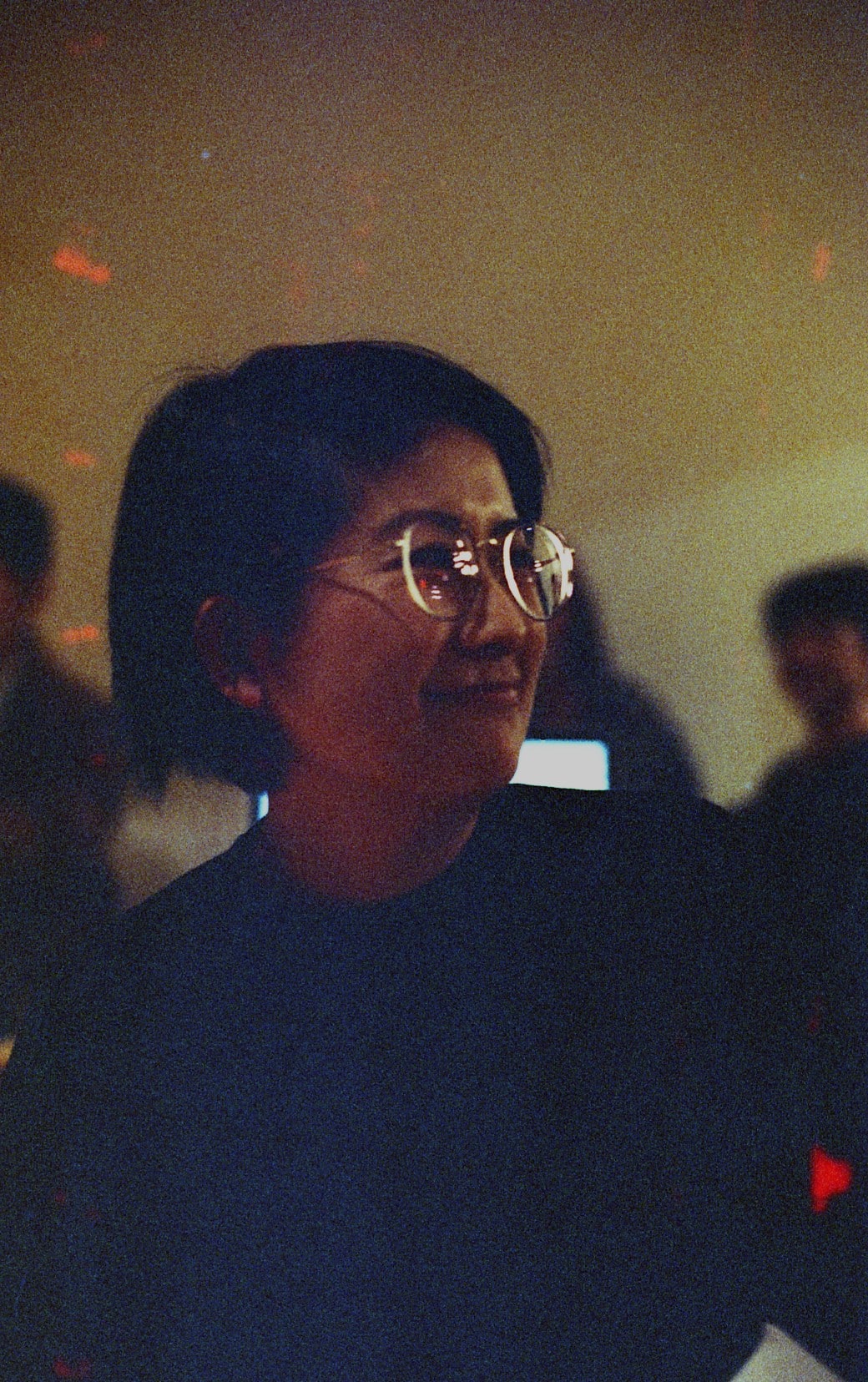
A talk, book launch and reception with Hong-Kai Wang to celebrate the launch of the book Our Words Don’t Suit Prophecies Anymore.
Currently based in Taipei, Taiwan, Hong-Kai Wang is an interdisciplinary artist working across exhibition making, performance, writing, publishing and education. Hong-Kai’s research-based practice is concerned with ethics of listening in relation to the politics of missing knowledge and memory. Her work seeks to examine divergent modes of attention and to conceive of emergent time-spaces that critically interweave histories of labor, economies of co-habitation, and the production of knowledge and desire.
This publication Our Words Don’t Suit Prophecies Anymore (co-published by Libby Leshgold Gallery and Taichung Art Museum) forms the basis of an installation of Hong-Kai’s work included in the exhibition A Call of All Being, presented at the Taichung Art Museum from December 2025–April 2026.
Contributors to the book are Haytham el-Wardany, Phoebe Giannisi, Gavin Steingo and Matariki Williams.
Haytham el-Wardany is a writer and translator, living and working in Berlin. He spent the last year listening to talking animals, in fables and elsewhere, and learned from them how to speak in moments of danger. His latest book, Jackals and The Missing Letters (Al-Karma 2023), considers forgotten expressions of hope within Arabic fables, where animals speak and humans listen, in a moment of post “Arab Spring” speechlessness. In previous publications, including The Book of Sleep and How to Disappear, Haytham has examined the potential of passivity, through regimes of listening and the dialectics of sleep and vigilance. He is the recipient of the Keith Haring Fellowship in Art and Activism 2022/2023.
Phoebe Giannisi is a poet born in Athens, Greece. Phoebe works as a professor at the University of Thessaly in the Department of Architecture in Volos, Thessaly. Her hybrid poetic work frequently slips between writing, performance and media. Working with animal poetics and land songs, she engages various methodologies including land-based field recording and performance to create a polyphony of voices and texts into what she calls chimeric poetics. She has curated exhibitions and poetic installations, and has presented poetry through expanded multimedia and performance formats. Her books have been translated in various languages, and, recently, Cicada (2022) and Chimera (2024), published by New Directions and translated by Brian Sneeden have been shortlisted for the National Award for Translation in Poetry in the United States. Her next book, Goatsong will be published by Fitzcarraldo in November 2025.
Gavin Steingo is a South African musician, scholar and activist. He is professor in the Department of Music at Princeton University, where he is also affiliated with the programs in Media & Modernity, Film Studies, Jazz Studies and African Studies. Gavin is the author of two books, Interspecies Communication: Sound and Music Beyond Humanity (2024), and Kwaito’s Promise: Music and the Aesthetics of Freedom in South Africa (2016), and co-editor of the book series “Critical Conjunctures in Music and Sound.” He co-directs The Animal Song Collective, a research initiative bringing together scientists and humanists to explore the idea of animal song from a cross-disciplinary perspective.
Matariki Williams, with tribal affiliations to Ngāi Tūhoe, Ngāti Hauiti, Taranaki, Ngāti Whakaue, Te Atihaunui-a-Pāpārangi, is a curator, writer and editor in the arts and cultural sector. In 2024-2025, Matariki held the Oroya Day Fellowship in New Zealand Art History in the Art History programme at Victoria University focusing on the continuum of Māori art practice and is currently teaching the Tohu Tiaki Taonga pilot programme at Te Wānanga o Aotearoa. Previous roles include as Senior Historian, Mātauranga Māori at the Ministry for Culture and Heritage and Curator Mātauranga Māori at Te Papa Tongarewa, the Museum of New Zealand. She is a committee member for Te Hā o Ngā Pou Kaituhi Māori – National Māori Writers Network. Matariki lives and works in Whakatāne, Aotearoa New Zealand.
Special thanks to Bobbi Kozinuk for providing radios and the transmitters and technical sound support, and Tien Zongyuan for exhibition design support at the Taichung Art Museum.