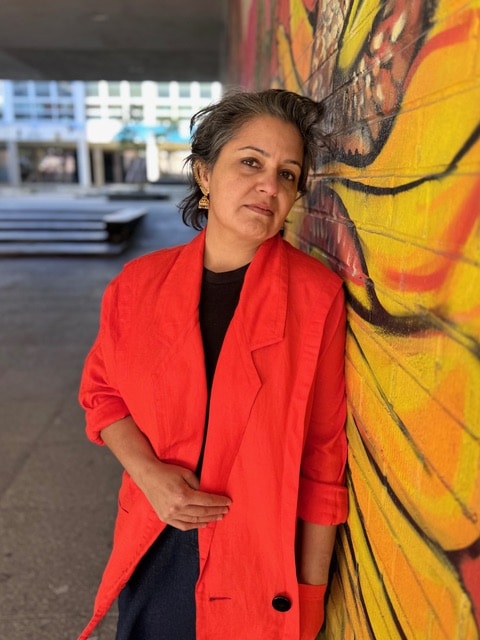
Join us for an in-person talk with artist Meera Sethi, followed by a discussion moderated by Dr. Natasha Bissonauth, Assistant Professor of Art History at ECU. All are welcome!
Meera Sethi is a New-Delhi born, Toronto-based visual artist with a process-oriented, interdisciplinary, and research-based practice that moves between painting, drawing, fibre, illustration, public art, performance, and social practice.
Her work sits at the intersection of the body and cloth with a particular focus on South Asia and its diasporas. She references histories of gender, labour, textile, environment, clothing, and migration.
Since 2023, Sethi has developed an abstract language of weaving with adhesive tape. These works carry a memory of cloth in their grid structure, however, also work as a language to address concerns such as memory, history and power.
Sethi’s work can be found in the permanent collection of the Royal Ontario Museum and the Wedge Collection. In Canada, it has been exhibited regionally at the Varley Art Gallery of Markham, Cambridge Art Galleries, The Art Gallery of Burlington, and The Aga Khan Museum among other venues.
She lives and works as an immigrant-settler in Tkaronto (Toronto, Canada), the traditional territory of the Anishnaabe, Haudenosaunee, Wendat, Chippewa, and Mississaugas of the Credit First Nation.
Natasha Bissonauth is Assistant Professor of Art History at Emily Carr University in Vancouver, BC. She received her Ph.D. in Art History at Cornell University in 2017 and her research centers queer aesthetics and archival logics across South Asia and Indian Ocean diasporas. She is currently working on a SSHRC-funded book project on collage that sutures and severs across legacies of immigration and indenture. Threading ‘areas’ like South Asia, the Caribbean, and Mauritius, Black and brown seams emerge as interruptions within the bordered logics of the art historical discipline.
Presented by the Audain Faculty of Art at Emily Carr University of Art + Design, Drawing & Sculpture