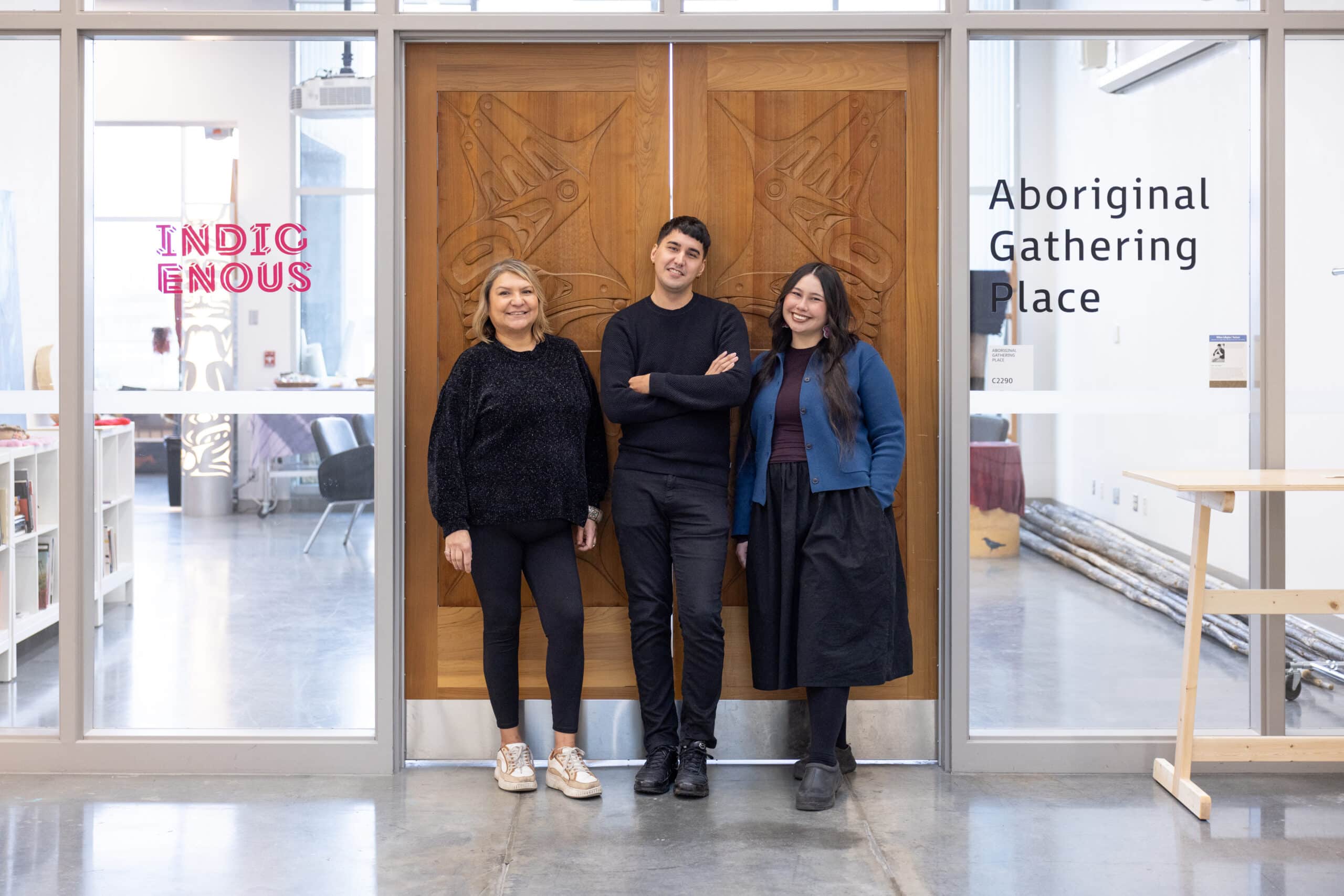
An upcoming exhibition and suite of public events celebrates more than a year of work by the Aboriginal Gathering Place.
A series of events hosted by the Aboriginal Gathering Place (AGP) at Emily Carr University of Art + Design (ECU) will celebrate 350+ Indigenous alumni whose connections to ECU were resurfaced after more than a year of archival research.
Throughout 2026, the AGP is honouring these alums with events including an exhibition featuring more than 50 emerging and acclaimed artists; a public symposium and Indigenous alumni gathering; and several partnered events in collaboration with regional arts organizations. The events are being held in conjunction with ECU100, ECU’s centennial celebrations.
“It feels really special to be creating this archive of Indigenous community members and seeing who’s come before me,” says AGP Research Assistant Leanne Inuarak-Dall (BFA 2025). “Looking back at all these people from years past and learning how their careers have evolved makes me, as someone who recently graduated, feel very hopeful. It’s especially exciting that we’ll now have a chance to be together and give new shape to our shared history.”
The research project was sparked in 2024 when Daina Warren (BFA 2003), Executive Director, Indigenous Initiatives at ECU and herself an ECU alum, was sorting through alumni records to find contacts for a historical gathering as part of ECU100.
“I realized people I knew or had studied with weren’t listed,” she says. “So, I asked AGP research assistant Vance Wright (BFA 2024) to do some research on whether we might be able to find more names beyond the folks I knew personally.”
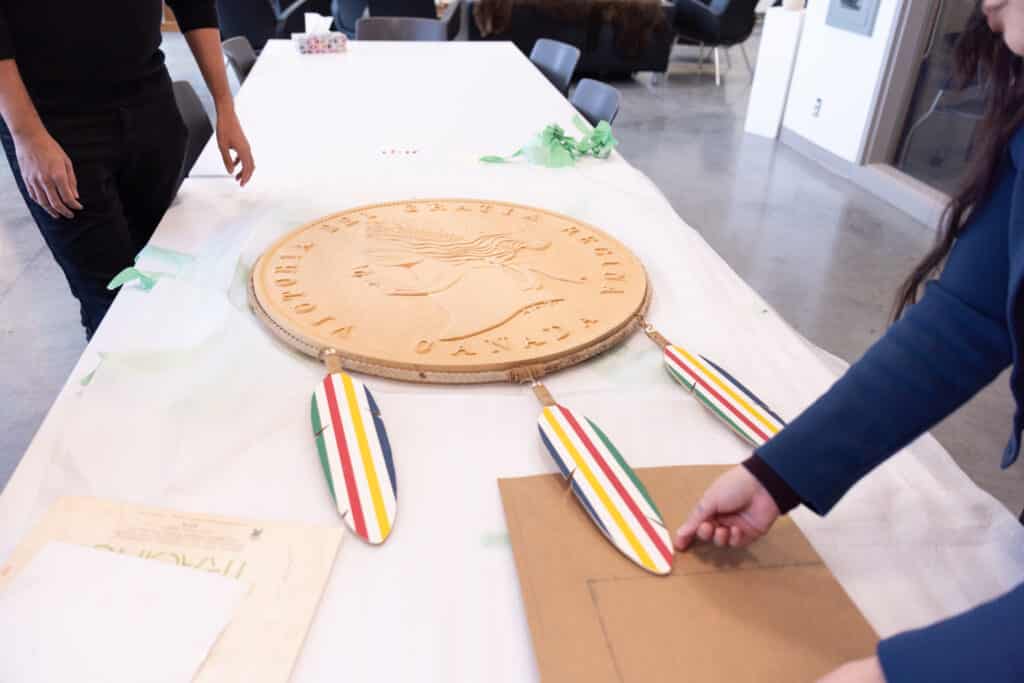
After combing public archives and internal records, Vance worked with ECU Archivist Kristy Waller to search the ECU Library + Archives. There, they discovered a trove of posters and other ephemera related to past ECU Indigenous art exhibitions.
Vance and Leanne pored over these materials to develop a roster of names. Through social media and online research, they worked for months to contact each person and confirm their identities. The pair were thrilled to discover the vast majority of these alums are still practicing artists working across a diverse range of creative fields, from writing and illustrating children’s books to working as painters, photographers and graphic designers.
“As an ECU alum myself, I remember thinking there was only one way a career can take shape,” Vance says. “Being able to share this research with current and future students feels like sharing a map for the many places they might travel. My hope is they’ll see themselves in one of these stories and feel empowered to do things their own way.”
The team’s work tripled the number of Indigenous alumni represented in ECU’s official records, from roughly 120 to more than 360 individuals. Yet Daina says there may be more still to be resurfaced.
The legacies of colonialism impact many Indigenous people’s willingness or ability to document connections to ancestral communities. Daina adds that self-identification is also deeply personal; every individual must contend with a unique constellation of histories, relationships and circumstances to affirm their right to their identity.
“ECU’s services and spaces for Indigenous students are somewhat recent in the university’s hundred-year history. Even when I applied to ECU in the late ‘90s, I was still just reconnecting with my own community and I questioned whether to identify myself to this institution as Indigenous,” Daina says.
“We see that to this day. We still have incoming Indigenous students who don’t feel comfortable taking advantage of the resources the AGP provides. And it’s part of our work to say to them, ‘This is all for you.’”
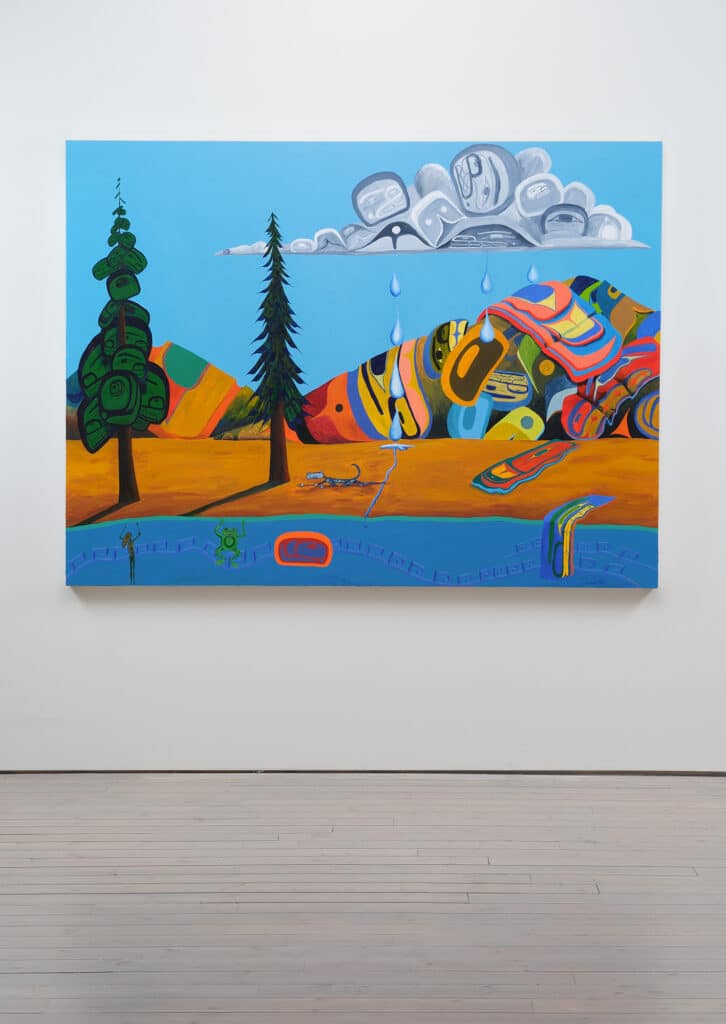
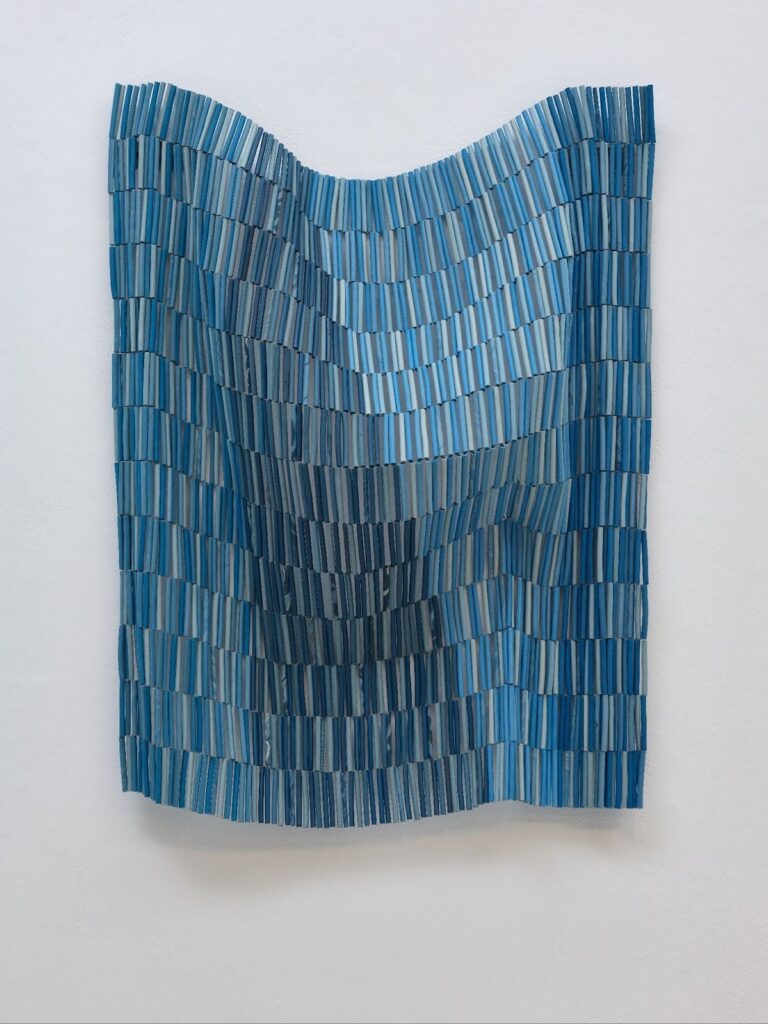
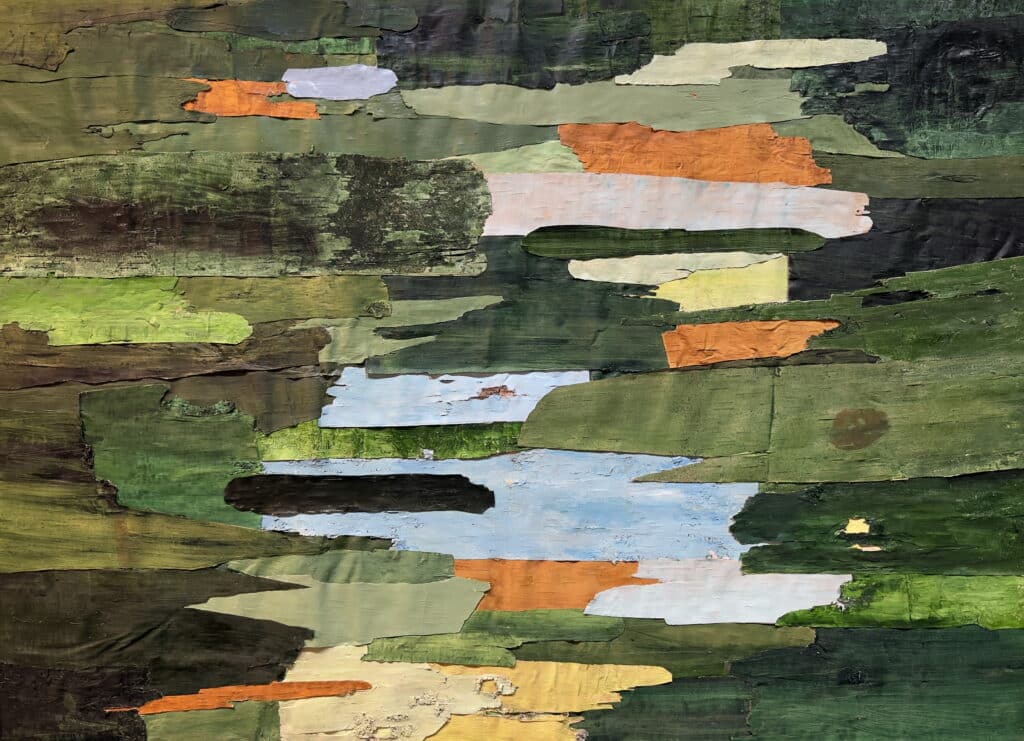
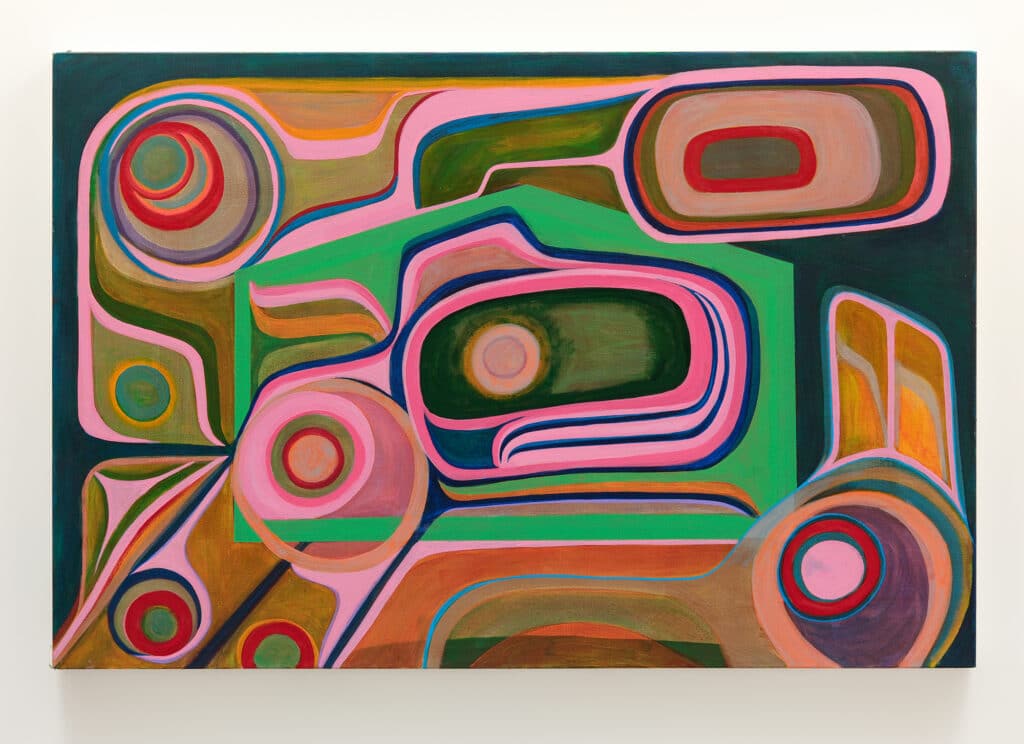
Dozens of ECU’s Indigenous alums will be represented in the upcoming exhibition, Somewhere We Have Travelled, showing Feb. 20 through March 7 at ECU. In addition to celebrated artists including Rebecca Belmore, Lawrence Paul Yuxweluptun Lets’lo:tseltun, Nadia Myre, Sonny Assu, Jeneen Frei Njootli and Michelle Sylliboy, the show includes work by current ECU students, staff and faculty. The exhibition features artworks generously on loan from the Morris and Helen Belkin Art Gallery Permanent Collection, Equinox Gallery, Unit17, Macaulay + Co. and Ceremonial Art.
Three alumni panel discussions will take place at the AGP on March 12, 19 and 26 from 5-7pm. The talks will be moderated by Rose Spahan and programmed through the ECU Career Development + Work Integrated Learning. In June 2026, a public symposium is planned and featuring artist talks with many more alumni will take place at ECU, as will an expanded edition of the AGP’s annual Indigenous Summer Market, an Urban Screen Programme with the Libby Leshgold Gallery at ECU and concurrent programming with partner institutions including The Blue Cabin Residency, grunt gallery and Macaulay + Co.
The AGP is grateful for support from ECU Career Development + Work Integrated Learning, the City of Vancouver, the Inuit Art Foundation and The Hamber Foundation as well as our partners, the Libby Leshgold Gallery, the Morris and Helen Belkin Art Gallery, Equinox Gallery, Other Sights, Unit17, Macaulay + Co and Ceremonial Art.
More About Aboriginal Programs at ECU
The Aboriginal Program Office provides culturally appropriate support that encompasses both traditional and contemporary artistic and cultural expressions of Aboriginal peoples, and is a valuable resource for students to access traditional materials/supplies.
The Aboriginal Program team also assists with the promotion and coordination of events and workshops related to Aboriginal art and culture, and is responsible for providing information regarding Aboriginal funding, scholarships and awards.
Visit the Aboriginal Gathering Place online to learn more about their programming and resources.
Want more stories like this one delivered twice a month to your inbox?
Subscribe to our FREE Emix newsletter today!