
By Ki Wight
Like many instructors, I am conflicted and somewhat exhausted by the topic of AI and how to respond to it in my teaching and learning designs. (A complaint: I didn’t ask for this technology, I don’t trust most developers of it, and I worry about the ways it seductively invites us to avoid the productive struggle of forming independent ideas.) Complaints aside, AI tools require us to rethink how we assess student learning, which is why I was so happy to discover The Opposite of Cheating podcast that makes learning designs, and not AI, the focus of conversation.
The Opposite of Cheating podcast is hosted by Drs. Tricia Bertram Gallant and David Rettinger, leading academic integrity scholars who research and showcase practical teaching strategies with the goal of “making cheating the exception and integrity the norm,” by connecting academic integrity to learning design.
In the podcast, Gallant and Rettinger interview instructors who have prominent voices in designing learning for AI-era higher education. Two episodes that I listened to underscore how social inequities are often connected to cheating and offer suggestions for designing assessments so students can showcase their learning and instructors can see where learning has not happened. For example, in Episode 36, Cath Ellis, the Pro Vice-Chancellor of Quality & Integrity at Western Sydney University, advocates for designing assessment that both inspires student learning and allows instructors to confirm and celebrate student learning.
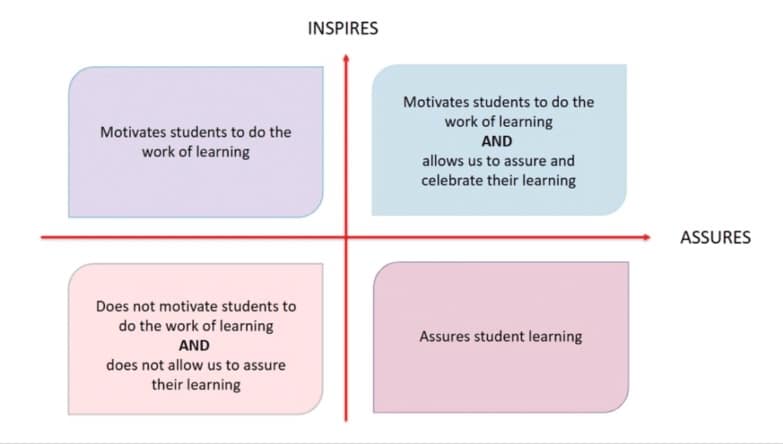
Ellis asks listeners to use this matrix to reflect on which tasks or assignments do and don’t motivate students to do the work of learning (inspire), and which help you, as the instructor, make confident judgments about learning (assure). To design assessments that “inspire and assure,” Ellis suggests instructors use the “FIRE” framework, where assessments: are Formative, offer Instant feedback, are Repeatable, and provide Evaluative judgement. You can listen to the full episode and learn more about Western Sydney University’s IA Approach to Assessment matrix here.
Episode #38 features the dynamic work of Drs. Hoda Mostafa and Maha Bali. Dr. Mostafa is a professor and Director at the Centre for Learning and Teaching at the American University in Cairo and Dr. Bali, a professor at the same university, is widely recognized for her scholarship on critical AI literacy. In addition to very practical teaching guides on topics like working against AI-shaming and compassionate learning design, this podcast episode highlights teaching practices that move beyond policing AI to engaging students critically in AI discourses and uses.
They suggest:
- Making cultural assumptions about academic integrity explicit
- Co-creating AI use guidelines with students
- Reframing AI use disclosure as metacognition to make student thinking visible
- Teaching AI attribution rigorously
- Building critical AI literacies early and often (like Michelle Ng’s workshop for students on AI Under the Hood)
Overall, this podcast has been helping me think of ways to check my own assumptions as an educator about what constitutes academic integrity or misconduct, while also offering interesting ways of planning, conceiving and understanding how to design teaching to make learning visible to students and instructors alike. If you don’t have time (or the inclination) to read Gallant and Bertram’s book of the same name, The Opposite of Pedagogy podcast offers some new and practical ideas to help us all navigate the new reality of assessment and AI.