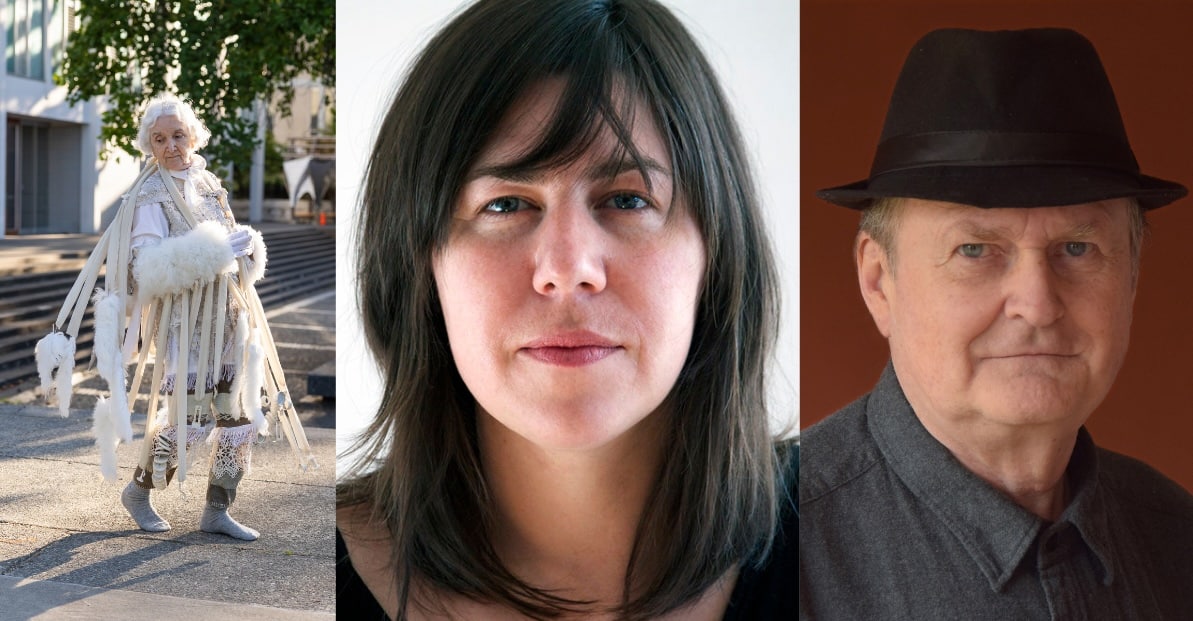
This year’s recipients will receive their honours during ECU’s convocation ceremony on May 8.
Emily Carr University of Art + Design is pleased to award 2024 Honorary Degrees to artist, performer, filmmaker and writer Carole Itter and experimental film artist, producer, director and curator Kirk Tougas, recognizing their spectacular achievements in the art world.
This year’s Emily Award will be presented to celebrated contemporary visual artist Nadia Myre, who graduated from ECU in 1997.
“I am thrilled to award this year’s Honorary Degrees and Emily Award to three deserving and venerable artists,” says Interim President + Vice-Chancellor Trish Kelly.
“From Kirk’s indelible imprint through Pacific Cinematheque and Canadian cinema, Carole’s large-scale and expansive works incorporating found materials, to Nadia’s exemplary artistry that touches on identity, language, and loss – each of these artists has shone a light on new ways of creation and artmaking. Their impacts are deeply felt in the art community as they continue pushing the boundaries of their disciplines.”
All three will receive their honours during Convocation on May 8, 2024.
Each year, the Honorary Degree Program celebrates and recognizes the commitment, dedication, and service of individuals distinguished by their significant contributions and sustained creative and philanthropic achievements in their areas of expertise.
The annual Emily Award Program recognizes the outstanding achievements of alum community members whose creative pursuits in the arts, media and design have brought recognition to the university.
Kirk Tougas is a noted experimental film artist, director of photography, producer, director, curator, past Trustee of the Vancouver Art Gallery, initiator of Xinema and founder of the Pacific Cinematheque in Vancouver, Canada.
With over 250 professional credits, he is recognized as one of Canada’s pre-eminent feature documentary cinematographers. Representing many cultural, anthropological, social and political themes, these films have been broadcast on every major network and have garnered more than 80 international festival awards, including Emmy and Peabody awards and 13 awards and nominations from the Canadian Academy of Cinema.
Creator of numerous experimental films, he has been described as a structural or conceptual artist. His experimental and personal films have broadly pursued three themes: the inherent nature of the film medium (and later, the digital video medium) and its message; portraiture and self-imaging as a human phenomenon from cave walls to the Selfie; and the poetics of a medium composed of image, sound and time.
Nominated for a Canadian Academy Award, he is best known for the politics of perception and the medium is the message, which, along with his other works, have been distinguished with screenings and installations in museums, universities, art schools, biennales and film/video festivals.
Carole Itter is an artist, performer, filmmaker, and writer known for her large-scale sculptures and installations made from found, discarded, and decomposed materials.
She studied fine art at the University of British Columbia, Vancouver School of Art and L’Accademia di Belle Arti in Rome in the fifties and sixties.
Carole joined her partner, musician, writer, and visual artist, the late Al Neil, at the Blue Cabin in Dollarton in the late 1970s. It was the start of a residency that would span more than 35 years. Though the cabin became a place of inspiration and art production for her, Itter still maintained her residence in the Vancouver neighbourhood of Strathcona, where she has lived since the early 1970s.
Carole is the recipient of both the VIVA Award and the Audain Award for Lifetime Achievement in the Visual Arts. In 2023, she was recognized with a major retrospective exhibition at the Morris and Helen Belkin Art Gallery.
Nadia Myre (born 1974) is a contemporary visual artist from Montreal, Quebec and an Algonquin member of the Kitigan Zibi Anishinabeg First Nation who lives and works in Montreal. For over a decade, her multi-disciplinary practice has been inspired by participant involvement as well as recurring themes of identity, language, and longing and loss.
Canadian Art Magazine writes of the artist, “Nadia Myre’s work weaves together complex histories of Aboriginal identity, nationhood, memory and handicraft, using beadwork techniques to craft exquisite and laborious works.” Through her body of work, Myre is interested in having conversations about collective identity, resilience and the politics of belonging. She graduated from Camosun College (1995) and Emily Carr University of Art and Design in Vancouver (1997) and holds a master’s degree in visual arts from Concordia University (2002). Myre has an extensive exhibition history, with over 115 shows—25 of which have been solos—just in the last ten years. Her work can be found in the National Gallery of Canada, Montreal Museum of Fine Arts, National Museum of Fine Arts of Quebec, the Canadian Museum of History and the Canadian Embassies of New York, London, Paris and Greece.
Myre is a recipient of numerous awards, notably Compagne des arts et des lettres du Québec (2019), Banff Centre for Arts Walter Phillips Gallery Indigenous Commission Award (2016), Sobey Art Award (2014), Pratt & Whitney Canada’s ‘Les Elles de l’art’ for the Conseil des arts de Montréal (2011), Quebec Arts Council’s Prix à la création artistique pour la region des Laurentides (2009), and a Fellowship from the Eiteljorg Museum (2003). In 2023 she was elected a Fellow of the Royal Society of Canada.