
Undergraduate Courses 101
Before you start building your schedule, it helps to know how courses are structured at Emily Carr University. From studio classes where you’ll be making and creating, to critical studies that build your academic foundation, each course has its own code, title and format.
This guide breaks down the terminology so you can read the course listings with confidence and know exactly what you’re signing up for.
Types of Courses
There are two categories of undergraduate courses at Emily Carr: studio based courses and critical studies courses.
Studio-based Courses
Studio-based courses include a studio component, where you will engage in making.
Studio-based Course – Titles + Acronyms
| 2D + Experimental Animation (2DAN) | Industrial Design (INDD) |
| 3D Computer Animation (3DAN) | Interaction Design (INTD) |
| Animation (ANIM) | Media (MDIA) |
| Ceramics (CRAM) | New Media + Sound Art (NMSA) |
| Communication Design (COMD) | Painting (PNTG) |
| Community Projects (CCID) | Performance (PERF) |
| Computer Graphics (CGIA) | Photography (PHOT) |
| Design (DESN) | Praxis (PRAX) |
| Drawing (DRWG) | Print Media (PRNT) |
| Film + Screen Arts (FMSA) | Sculpture (SCLP) |
| Forums (FRMS) | Sound Art (SOUN) |
| Foundation (FNDT) | Visual Arts Studio (VAST) |
| Illustration (ILUS) | Writing (WRTG) |
Any program requirement listed as “open studio” can be fulfilled by these courses.
Critical Studies Courses
Critical studies courses are classroom-based academic courses. Studio-based courses include a studio component, where you will engage in making.
You must complete all first and second year critical studies requirements for your major before registering in third year critical studies courses. Studio-based courses include a studio component, where you will engage in making.
Critical Studies Courses – Titles + Acronyms
| Art History (AHIS) | Media History (MHIS) |
| English (ENGL) | Science (SCIE) |
| Design History (DHIS) | Social Science (SOCS) |
| Humanities (HUMN) |
Humanities, social science and science courses
- Humanities courses include: philosophy, literature, classical studies and languages.
- Social science courses include: psychology, anthropology, political science, sociology and women’s studies.
- Science courses include: biology, chemistry, earth science, wood science, physics, astronomy, oceanography and mathematics.
Course Codes
Each course at ECU has a unique course code.
Course code format: Subject – Course Number – Section Number – Course Title (Synonym)
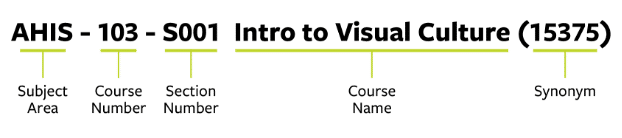
Subject code: Identifies the subject area (e.g., AHIS = Art History).
Course number: Indicates the level of the course.
- 100–199 = First year
- 200–299 = Second year
- 300–399 = Third year
- 400–499 = Fourth year
Section number: Distinguishes multiple sections of the same course. The first letter shows the term:
- F = Fall
- S = Spring
- SU = Summer
- The number after the letter identifies the specific class.
The synonym is only used for registration.
Example
AHIS-103-S001 Intro to Visual Culture (15375)
- AHIS = Art History (subject)
- 103 = First-year course
- S001 = Spring term, section 001
- Intro to Visual Culture = Course title
- 15375 = Synonym