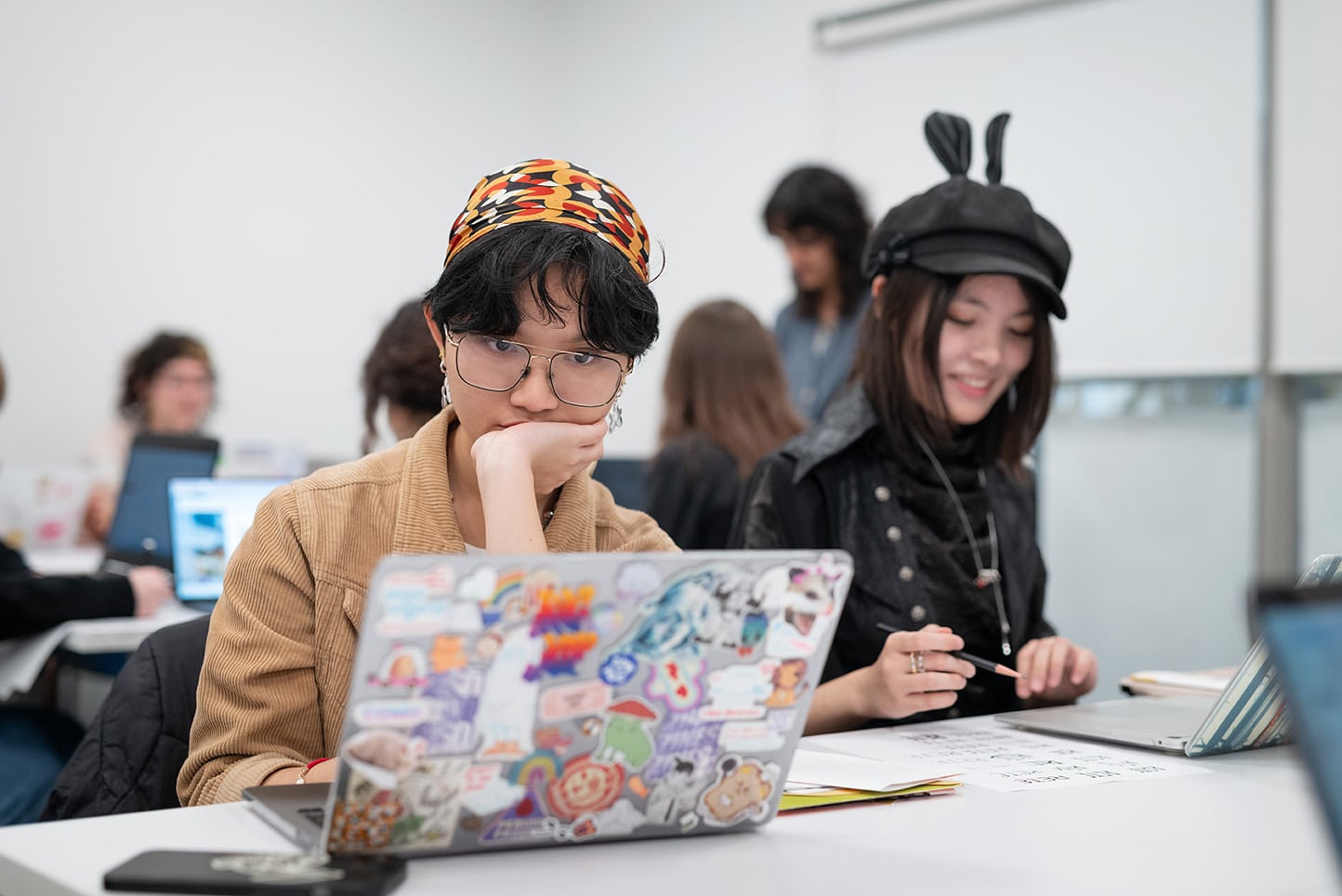
Special Topics courses open space for new ideas and emerging practices across art, media and design.
They sit just outside the regular program structure, creating room to experiment, test new approaches and respond to what’s happening now. Some are timely. Some are exploratory. All reflect current creative practice.
Special Topics offerings are updated once per semester, so the list changes regularly.
Spring 2027 Semester: January 4 – April 13
What makes a course a Special Topic?
Special Topics courses focus on subject matter that is not fixed. The topic changes from term to term and is shaped by current issues, emerging technologies, or faculty research and studio practice.
They are often more experimental or exploratory than regular courses and may be offered for only one or two terms. Special Topics can appear at different course levels and count toward degree requirements in the same way as other electives.
How do Special Topics relate to electives?
Elective describes how a course fits into your degree, not what the course is about. Many types of courses can be electives, including studios, seminars, and Special Topics.
All Special Topics courses are electives, but not all electives are Special Topics. While electives may include standard, recurring courses, Special Topics stand out because their content changes and reflects current thinking and evolving creative practices
Below are Special Topics course offerings across all undergraduate faculties for the current and upcoming semester. Students can find and register for these courses via the MyEC Course Catalogue.
Courses marked as Cross-listed will indicate the corresponding course sections.
For a full list of courses being offered in the next term, please visit the Course Catalogue at myec.ecuad.ca.
Faculty of Art Special Topics
ILUS 305 S005H– Illustration Genres: Topic (3 credits)
CC/PRNT 305 S005H
Wednesdays 3:25-6:15pm A4080/D4320
Instructor: Chelsea O’Byrne
Topic: Making Meaning Through Materiality
Description:
In this course, students will expand their illustration and printmaking practices through a deep investigation of materiality. Working with monotype and illustration as symbiotic processes, students will develop innovative approaches to narrative art using experimental materials to create printed components for their work. This course will include in-class tutorials on monotype printmaking, processing pigments, and making handmade paints, inks, and paper. We will also explore translating three-dimensional objects to two-dimensional formats, and strategies for incorporating analogue prints into digital interfaces. Assignments will consist of research, readings, and studio projects with a focus on how materiality and narrative can enhance each other.
ILUS 305 S002– Illustration Genres: Topic (3 credits)
Wednesdays 8:30-11:20am D4325
Instructor: Adam De Souza
Topic: Making Comics
Description:
In this course, students will investigate comics as an artistic form, while developing their own comic-making practice. Throughout the course, students will develop their own short comic stories. Students will be introduced to the practical ins and outs of comics publishing at multiple scales: from self-publishing to working with a major publisher. Further, this course will guide students through the reality of the development process for a graphic novel, from initial concept and pitch, with an eye towards the publishing industry. Through in-class discussions, exercises, and in-depth critiques, students will develop their understanding of how comics are made and will be better prepared for the realities of entering the comics publishing world.
ILUS 305 S091– Illustration Genres: Topic (3 credits)
Thursdays 3:25-6:15pm online
Instructor: Jim Holyoak
Topic: Storytime
Description:
This course explores the many ways that stories are imagined, told, illustrated, performed, and shared. Students will investigate (sub)genres such as myths, fairy tales, allegories and epics, as well as contemporary forms such as comics, speculative fiction and improvised role-playing, to uncover the possibilities of storytelling. This course invites students to reinvent familiar narrative forms through various experimental strategies of image-making. Students will be encouraged to develop their own approaches to visual narration in the form of projects and assignments, while sharing work and engaging with one another’s ideas through discussions and critiques.
PRNT 305 S005H – Print Media: Special Topics (3 credits)
CC/ILUS 305 S005H
Wednesdays 3:25-6:15pm A4080/D4320
Instructor: Chelsea O’Byrne
Topic: Making Meaning Through Materiality
Description:
In this course, students will expand their illustration and printmaking practices through a deep investigation of materiality. Working with monotype and illustration as symbiotic processes, students will develop innovative approaches to narrative art using experimental materials to create printed components for their work. This course will include in-class tutorials on monotype printmaking, processing pigments, and making handmade paints, inks, and paper. We will also explore translating three-dimensional objects to two-dimensional formats, and strategies for incorporating analogue prints into digital interfaces. Assignments will consist of research, readings, and studio projects with a focus on how materiality and narrative can enhance each other
VAST 310 S001P – Visual Arts: Special Topics (3 credits)
CC/ INDD 307 S001P
Fridays 8:30-11:20am C3235
Instructor: Heather Young
Topic: Textile Production
Description:
This intensive course builds off an initial personal garment study. A deconstructive assessment of existing garments will provide the basis to map out origin, material, construction and technical drawings. The second project builds from lessons in weeks 1-6 patterning and is designed to offer space for construction exploration. Alternate patterning, structural requirements, and internal considerations will be introduced for the creation of a textile object. Illustrated lectures, readings, videos and group discussions will be used to introduce topics throughout the semester.
Faculty of Culture + Community Special Topics
AHIS-325-S001 Studies in Modern Art
Tuesdays, 8:30am – 11:20am
Instructor: S. Hart
Topic: The Modern Social Imaginary
Description: TBA
AHIS-333-S001 Interdisciplinary Forums
Wednesdays, 12:20pm – 3:10pm
Instructor: S. Rodrigues
Topic: TBC
Description: TBC
AHIS-336-S001 Hist + Contemporary Movements
Tuesdays, 12:20pm – 3:10pm
Instructor: Y. Kong
Topic: Participatory Art
Description:
During the twentieth century and leading into the contemporary, there has been surges of artistic interest in participation and collaboration in North America and internationally. This expanded field of practices is sometimes referred to as socially engaged art, community-based art, dialogic art, interventionist art, collaborative art, social practice, and participatory art. These terms typically describe practices and artworks that refer to the involvement of many people (as opposed to one-on-one interactions) and consider how art responds to and enters into a collaborative dialogue with its environment and the viewer as participant. In this class, we will consider the activation of the viewer both individually and collectively, as well as the social dimensions of participation in a period that spans roughly the last century, from 1920s until present. Moving between theoretical frameworks and historical antecedents, this class begins by exploring notions of authorship and follows participatory art movements from the Avant-Garde, the Situationists, Fluxus, experimental performance, relational aesthetics, pedagogical projects, contemporary projects, and reception aesthetics. Our aim is to press on the relationship between the artist, artwork, viewing environment, and activated spectator, with consideration to the quality of participation. How do spectators participate and in what ways do they contribute to the artwork, if at all?
AHIS-401-S001 Topics in Curatorial Projects
Fridays, 12:20pm – 3:10pm
Instructor: P. Andersson
Topic: TBA
Description: TBA
AHIS-410-S001 Topics in Global Art
Mondays, 12:20pm – 3:10pm
Instructor: B. Mohammadi
Topic: All the Ways Art Has Failed Us
Description:
This is a course of art historical anecdotes from the 20th and 21st centuries that reveal the failure of Global North art, architecture, and design to deliver on their empty promises of “progress.” By foregrounding feminist, postcolonial, and ecological theories, we will expose how the modernist promise of progress was built on and perpetuated exclusion of difference, of the non-Western, of the non-human, of the Other.
Students will analyze art, architecture, and design as both products and critiques of their time, thinking deeply about what art is and does. We will visit sites across Vancouver to see how axes of discrimination have materialized in built environments and objects. Combining critical theory with creative practice, this course offers an anticolonial and ecologically attuned rethinking of Western art history as a history of failure, and a challenge to imagine socially, ethically, and ecologically just art.
AHIS-420-S001 Topics in Feminist, Gender, Cultural Studies
Wednesdays, 12:20pm – 3:10pm
Instructor: S. Shon
Topic: Feminism Without Borders
Description:
Liberal feminism has cast “gender” as a subject of social violence and inequality and subsequently placed “rights” as the primary way to address gendered subjection and located the state responsible for distributing and enforcing political rights of citizens. The liberal feminist strategy has justified state-sponsored policing, surveillance, and militarization. Yet Black, Third World, Women of Colour, and Transnational feminist thinking across forms and media have challenged these consolidations of state power by offering “aesthetics” as entry point to social transformation. AHIS 420: “Feminism Without Borders” studies such works as foundational frameworks for examining “gender” as category for anti-colonial action in racial capitalism, colonialisms, racist nationalisms, the idea of borders, and mass dislocations and migrations.
HUMN-305-S001 Studies in the Humanities
Mondays, 3:25pm – 6:15pm
Instructor: R. Wong
Topic: Solidarity: A Work in Progress
Description: TBA
HUMN-306-S001 Studies in Humanities: Design
Fridays, 8:30am – 11:20am
Instructor: R. Camozzi
Topic: Making Life – ECOL
Description:
Through workshops, readings, dialogue, and small acts of making, students will consider design as a way of paying attention to our values, noticing relationships, adapting, practicing generosity, engaging with energy, transformation, and the imagination needed to sustain hope. We will do this by challenging what we have been taught to believe an expedition is. A relevant example, Kate Flether spoke at the school earlier this year posing the question, what if we brought no plastic on an outdoor hike in a wet climate? These changes in awareness are what we hope to explore in this course; unlearning summiting/getting to the end as fast as possible.
Students will be designing a summer experience that traces how themes discussed in the course might be experienced through camping, walking, floating, immersion, or time spent in place. Design can be something that transforms not only what we make, but how we see, know, and belong. This course is for students that want to participate, expect most classes to be hands on, attending several local field trips, and full of discussion in varying group sizes.
Major Assignment :
Summer Expedition: Design a summer expedition that treats the senses, relationships with more than human beings and lived experience as primary sources of design knowledge. Reimagine what preparation, movement, connection, participation, and wayfinding can look like when they are guided by an attention to the living world. Note: Students will not be reporting back on their expeditions.
HUMN-309-S001 Cross Cultural Design
Fridays, 8:30am – 11:20am
Instructor: M. Barcham
Topic: TBA
Descripton: TBA
HUMN-311-S001 Visual Art Seminar
Tuesdays, 12:20pm – 3:10pm
Instructor: M. MacKenzie
Topic: “Humour”
MHIS-329-S001 Studies in Current Film/Video
Thursdays, 12:20pm – 3:10pm
Instructor: J. Clark
Topic: Landscapes of Extraction: Film, Space and Power
Description:
In her book, “Where Histories Reside”–Priya Jaikumar lays out a notion of filmed space that links the filmic space of the screen to the profilmic world – in doing so her work asserts that “filmed spaces are a part and a product of cinematic, social, industrial, imagined, and political spaces.” As such they are “instrumental in the sense that they are shaped by state and institutional power, aesthetic and narrative regimes, market forces, and social hierarchies.” In this course, we will examine the instrumentality of filmed space – not only insofar as it is shaped by these forces, but how filmed spaces might also serve to shape structures of power and systems of resource extraction.
In the first half of the course, we will focus on the ways in which cinema depicts and shapes landscapes – both onscreen and in the extra-cinematic world. In the second half of the course we will examine cinema as it relates more specifically to systems of resource extraction. Throughout the course we will pay special attention to the political dimensions of filmed space – how it relates to systems of power such as capitalism, colonialism, and environmental racism; as well as how it might be used to resist to these systems.
MHIS-407-S001 Themes in Interactivity
Fridays, 12:20pm – 3:10pm
Instructor: TBA
Topic: TBA
Description: TBA
MHIS-429-S001 Topics in Film + Media Theory
Wednesdays, 3:25pm – 6:15pm
Instructor: S. Shamash
Topic: Coming-of-Age in the Pluriverse
Description:
If we understand pluriversality, “a world where many worlds fit,” as a decolonial concept articulated to counter universalist claims of western modernity, how does a study of the coming-of-age genre from a pluriversal perspective function as a lens to energize and decolonize the historically established Hollywood genre? Emerging as a distinct genre in the 1950s, the youth film developed when Hollywood recognized the purchasing power of the baby boom generation (Berghann, 2010) often depicting rebellious white, male, middle-class American youth (i.e. Rebel Without a Cause, 1955, Dir. Nicolas Ray, The Graduate, 1967, Dir. Mike Nichols). While the teen pic genre has been largely framed within the American paradigm and context of production, Coming-of-Age in the Pluriverse examines the coming-of-age genre from Black, Indigenous, diaspora, and Global South narratives. What is the role of geo-social-cultural-political contexts of production in understanding coming-of-age narratives from the pluriverse? Through core readings, discussions, lectures, and presentations, we will delve into a cinematic investigation of the coming-of-age genre from the pluriverse.
SCIE-300-S001 Studies in the Sciences
Mondays, 8:30am – 11:20am
Instructor: S. Guvenc-Salgirli
Topic: Obscurities
Description:
The dictionary entry for obscure marks dimness, cloudiness, darkness, blurriness, and duskiness in spaces and surroundings, and vagueness, unintelligibility, and indecipherability in words and meaning. Depending on these two lines this course is going to explore obscurity in all its possible extensions. What is looked at but not seen; what is read but not comprehended; what is desired but not known; what is listened but not heard will be some of the treads that we are going to delve into; and ambient sounds, infrared, dark matter, void, and objet a are some of the things we will trace. As for content, we will rely on a large scope of readings ranging from science to medicine, and from psychoanalysis to trans and queer literature. The aim of this course is totravel with obscurities and traverse that space with creative thinking and making. The one thing that is not needed for this course is prior knowledge in any of these areas as it is precisely acourse that would like to reconnoitre what happens when knowledge is at bay.
SOCS-300-S001 Studies in the Social Sciences
Tuesdays, 3:25pm – 6:15pm
Instructor: S. Guvenc-Salgirli
Topic: Art and Psychoanalysis
Description:
In his study of Marguerite Duras’s Lol V Stein novel, the famous French psychoanalyst Jacques Lacan wrote, “the artist always precedes the analyst and that the analyst does not have to play the psychologist where the artist paves the way for him.” In that spirit this course creates an encounter, a chance meeting between the two fields of art and psychoanalysis. Together, we wil look into some of the concepts that are at the intersection of both fields such as trauma, sexuality, waste, love, and desire, and try to ask and answer questions such as: who is the subject of psychoanalysis? How does psychoanalysis view love? Where is the obscure object of desire to be sought? How is it possible to voice trauma? Circling around these questions our inspiration will be from artists whose work have grown alongside psychoanalysis (eg. Louise Bourgeoise, Marcel Broodthaers, Leonora Carrington), artists who inspired psychoanalysts (eg. Claud Cahun, Hans Holbein, Gustave Courbet), and artists whose works stand at the edges of both fields (eg.Berlinde De Bruyckere).
SOCS-300-S001 Studies in the Social Sciences
Thursdays, 3:25pm – 6:15pm
Instructor: C. Ewart
Topic: TBA
Description: TBA
SOCS-302-S001 The Ethics of Representation
Mondays, 12:20pm – 3:10pm
Instructor: S. Shamash
Topic: TBA
Description: TBA
SOCS-302-S002 The Ethics of Representation
Tuesdays, 3:25pm – 6:15pm
Instructor: S. Shamash
Topic: TBA
Description: TBA
WRTG-301-S001 Special Topics in Writing
Wednesdays, 3:25pm – 6:15pm
Instructor: A. Zuliani
Topic: The Short Story
Description
In this class, we will dedicate ourselves to the crafting of the most dynamic and compact of narrative forms: the short story. Through demonstrations, workshops, and in-class writing experiments, we will develop narrative techniques which lend themselves to plot, characterization, world-building, and dialogue-writing. Over the course of the semester, students will develop one or more works of short fiction while serving as readers and supporters of each other’s work, and will leave the class with polished pieces of writing and a newly deepened and broadened sense of their own storytelling voice.
WRTG-401-S001 Senior Writing Studio
Tuesdays, 8:30am – 3:10pm
Instructor: M. Eng
Topic: TBA
Description: TBA
Faculty of Design + Dynamic Media Special Topics in Animation
ANIM 350 S001U – Special Topics in Animation
***Cross-listed w/ FMSA 327 S001U
Tuesdays 8:30-11:20AM
Instructor: Ruben Moller
Topic: Set Design
Set design is a cross-disciplinary practice. This course is designed for students who are interested in learning about working on or designing sets for film and digital media production. It will focus on the basic techniques and skills needed in set design and developing the look of a film or digital media production. The course is primarily geared towards students in FMSA, NMSA, and ANIM but of interest and relevance to Design and Visual Arts students.
ANIM 350 S002G – Special Topics in Animation
***Cross-listed w/ FMSA 420 S002G – Special Topics in Film
Tuesdays 8:30-11:20am
Instructor: To be confirmed
Topic: Breath and Pulse: Scoring to Picture
This studio course moves students from scoring individual scenes to crafting their unique voice within a compositional portfolio, developing a range of tools suited for a variety of media scenarios, and to working as a composer across a complete project. Students develop original thematic material across extended musical and narrative arcs, score for real instruments, and engage directly with the business, collaborative, and ethical dimensions of a contemporary composing practice. The course opens with a short foundational review so that students arrive at a shared starting point regardless of prior coursework, then moves quickly into territory no introductory course covers. Repeatable for further credit as topics and visiting practitioners vary.
ANIM 350 S031V – Special Topics in Animation
***Cross-listed w/ FMSA 350 S031V – Special Topics in Film
Wednesdays 8:30-11:20am
Instructor: Lee Carroll
Topic: Producing for Film + Animation
Producing for film and animation demands both artistic vision and strategic acumen. Producers are by nature conversant in creative aspects such as story and structure, as well as market awareness and entrepreneurial strategies. In the contemporary environment, producers are called to be conversant in creative techniques, workflows, markets and distribution opportunities for both film AND animation.
Through lectures, screenings, workshops, critiques, and production-based assignments, students develop a concept from conception to pitch-ready packaging. Students implement producing concepts in individual and collaborative work. Emphasis is placed on concept development, production strategies, scheduling, and market positioning and planning.
ANIM 350 S032 – Special Topics in Animation
Tuesdays 6:25-9:15pm
Instructor: Alisha Steinberger
Topic: Creature Animation
This upper-division course provides an in-depth study of creature animation through the lens of animal anatomy, biomechanics, and behavioral analysis. Students will integrate artistic interpretation with technical execution to animate both realistic and fantasy creatures. Emphasis is placed on understanding anatomical structures and motion principles to inform believable animation choices. The course covers efficient rig control systems, including IK/FK switching, space switching, and rotation order optimization. Students will develop animation cycles that represent distinct quadruped gaits—such as walk, trot, canter, gallop, and run—and learn to implement effective workflows using industry-standard 3D animation tools. By the end of the course, students will be able to analyze and synthesize animal behaviors and expressions to create performances that demonstrate authenticity and appeal, with technical sophistication for the creation of a portfolio piece.
ANIM 350 S033 – Special Topics in Animation
Wednesdays 6:25-9:15pm
Instructor: Ray Luc
Topic: Blender NPR
This course will cover the basics of Blender, as well as more intermediate techniques with a focus on stylised FX and hybrid 2.5D animation. We will be exploring hand-drawn, intuitive ways of working, and the main tools covered include grease pencil, modifiers, geometry nodes, scripting, rendering with Cycles/EEVEE, and the Blender in-engine compositor.
As experimental animation continues to advance in the mainstream and independent industries, we will also be covering how to utilise 2D animation principles (such as flash frames, brush strokes, and smears) in a 3D software.
ANIM 350 S034 – Special Topics in Animation
Mondays 6:25-9:15pm
Instructor: U. Gocer
Topic: Procedural Modeling
This intermediate course explores Houdini’s procedural tools for modelling. Students will expand their 3D modeling skills developing node-based workflows for generating complex and dynamic environments. Emphasis is placed on building efficient non-destructive iteration networks, with volumetrics such as height fields, custom attributes, data flow, and export methods to other software applications. By the end of the semester, students will create procedural models that demonstrate technical and creative problem-solving.
ANIM 350 S035 – Special Topics in Animation
Thursdays 6:25-9:15pm
Instructor: Donald Chan
Topic: 3D Character Acting
This course advances skills in 3D character animation with a focus on acting, performance, and storytelling. Students will learn to craft scenes that convey emotion and personality. The course emphasizes facial appeal, unique performance choices, and creating entertaining animation. Assignments centre on observing and analyzing reference to develop believable character performances, as well as exploring multi-character dynamics. Instruction includes lectures, demonstrations, and critiques.
Faculty of Design + Dynamic Media Special Topics in Film
FMSA 350 S031V – Special Topics in Film + Screen Arts
***cross-listed w/ ANIM 350 S031V – Special Topics in Animation
Wednesdays 8:30-11:20am
Instructor: Lee Carroll
Topic: Producing for Film + Animation
Producing for film and animation demands both artistic vision and strategic acumen. Producers are by nature conversant in creative aspects such as story and structure, as well as market awareness and entrepreneurial strategies. In the contemporary environment, producers are called to be conversant in creative techniques, workflows, markets and distribution opportunities for both film AND animation.
Through lectures, screenings, workshops, critiques, and production-based assignments, students develop a concept from conception to pitch-ready packaging. Students implement producing concepts in individual and collaborative work. Emphasis is placed on concept development, production strategies, scheduling, and market positioning and planning.
FMSA 420 S002G – Special Topics in Film + Screen Arts
***Cross-listed w/ ANIM 350 S002G – Special Topics in Animation
Tuesdays 8:30-11:20am
Instructor: To be confirmed
Topic: Breath and Pulse: Scoring to Picture
This studio course moves students from scoring individual scenes to crafting their unique voice within a compositional portfolio, developing a range of tools suited for a variety of media scenarios, and to working as a composer across a complete project. Students develop original thematic material across extended musical and narrative arcs, score for real instruments, and engage directly with the business, collaborative, and ethical dimensions of a contemporary composing practice. The course opens with a short foundational review so that students arrive at a shared starting point regardless of prior coursework, then moves quickly into territory no introductory course covers. Repeatable for further credit as topics and visiting practitioners vary.
Faculty of Design + Dynamic Media Special Topics in Design
COMD 350 S001A – Topics in Communication Design
Tuesdays 8:30-11:20am
Instructor: Cameron Neat
Topic: Riso_Graphic Narrative
This course will take a graphic and visual approach to authorship, narrative and storytelling while exploring the potential of risograph printing. Informed by the study of graphic literature and comics, this studio will develop and support practices in authoring, drawing and disseminating graphic narratives. The class will be structure around creative prompts aimed at workshopping concepts and developing skills in drawing and risograph printing while reading assignments in graphic literature will support our making. The course will culminate with six week self-directed term project.
COMD 350 S002 – Topics in Communication Design
Fridays, 8:30-11:20am
Instructor: Janine Merkl
Topic: Creative Direction / Digital Platforms
This COMD studio elective aims to familiarize students with concepts, methods and practices related to creative direction for digital platforms. Through projects and design proposals students will gain experience in developing communication campaigns that encompass screen based, interactive, motion graphic and multi-modal dimensions.
COMD 350 S003 – Topics in Communication Design
Wednesdays 3:25-6:15pm
Instructor: To Be Confirmed
Topic: Motion Graphics/Dynamic Identity
This COMD studio elective aims to familiarize students with concepts, methods and practices related to motion graphics as it applies to visual identity design. Through projects, tutorials and exercises students will advance their knowledge of motion design while exploring its application in developing dynamic visual identities.
INDD-350-S001Q – Topics in Industrial Design ***Cross-listed w/NMSA-206-S001Q
Wednesdays 3:25-6:15pm
Instructor: Valerie Walker
Topic: Creative Electronics
This course is designed for students with no prior knowledge of electronics. The course introduces students to Maker and DIY culture practices as they pertain to interactive objects and electronics as new media art and design forms. Students will explore open-source software paired with readily available electronic hardware to create programmable objects that make sound, light or movement. The course includes workshops in electronics, circuitry, triggering and control devices, and presentations on artists working in the field of creative electronics. Successful completion will provide a working knowledge of basic electronic applications.
DESN 350 S001 – Special Topics in Interdisciplinary Design
Saturdays 12:20-3:10pm
Instructor: Splash Nelson-Moody
Topic: Metal Connections
This course will include several projects for students to explore expressions of identity and culture through small-scale metalwork adornment and storytelling. Initial project focus will be on personal expressions of each students positionality and self identity, with emphasis on responsibility to community and environment.
Smaller projects might include items such as jewelry (necklace, earrings), or clothing-fasteners (buttons, hooks, or buckles). Medium-sized projects may include items such as bracelets, chain (maille), or plates (eg. a gorget).
Objects may be transformed from the found or repurposed, or developed from fresh stock with considerations of the lifecycle of the material. Primary development of hands-on skills in this course could continue into jewelry and related fields, or be useful for one-off or custom production, prototyping, or developing recycling procedures. This course may dovetail nicely with INDD310.
DESN 350 S002 – Special Topics in Interdisciplinary Design
Fridays 12:30-3:10PM
Instructor: Morgan Martino
Topic: DESIS Spring Studio
This studio course embeds students within Emily Carr’s DESIS (Design for Social Innovation and Sustainability) Lab; Canada’s only node in an international network of design-led research labs which support social change towards sustainability. Projects in this course will emphasize collaborative, sustainable, and socially-engaged approaches to design research and practice. Students will engage with and develop insights into vernacular design, pluriversal design, and design for more-than-humans as methods for supporting local community and environmental needs and desires. This course will empower students in developing approaches to design that are participatory and contextually grounded through research, workshops and other community-based activities.
DESN 350 S003W – Special Topics in Interdisciplinary Design
Wednesdays 3:25-6:15PM
Instructor: Chepximiya Siyam’ Janice George, Skwetsimeltxw Willard ‘Buddy’ Joseph
Topic: Coast-Salish Weaving
Students will learn the fundamentals of Salish weaving through immersive, hands-on practice while developing an understanding of design as both a technical and cultural practice. Guided by the teachings of Elders and grounded in Indigenous ways of knowing, students will explore weaving as more than a technique. It is a way of being in the world, a communal act of care, and a way of carrying history, culture, and worldview into the present. Students will learn Coast Salish protocols for working with materials, knowledge, and ideas in a good way, while reflecting on the sacredness, relationships, and responsibilities carried within the fibres. Students will create a body of woven work while developing discipline, presence, care, and reciprocity. Through making, reflection, and shared learning, they will recognize weaving as both an individual and collective practice, shaped by the many hands and spirits that sustain it. Engaging with Salish teachings, history, and contemporary practice, students will deepen their sense of purpose as artists and cultural practitioners while learning to honour traditions and explore new creative directions.
This course is an intensive that takes place over reading week (February 16-19).
Classes will be in person from 9-6, Tuesday through Friday, with some online preparatory work expected prior to the first day of class.
This course is intended for weavers with foundational experience who are already familiar with basic weaving techniques, including twining, twill, and tabby.