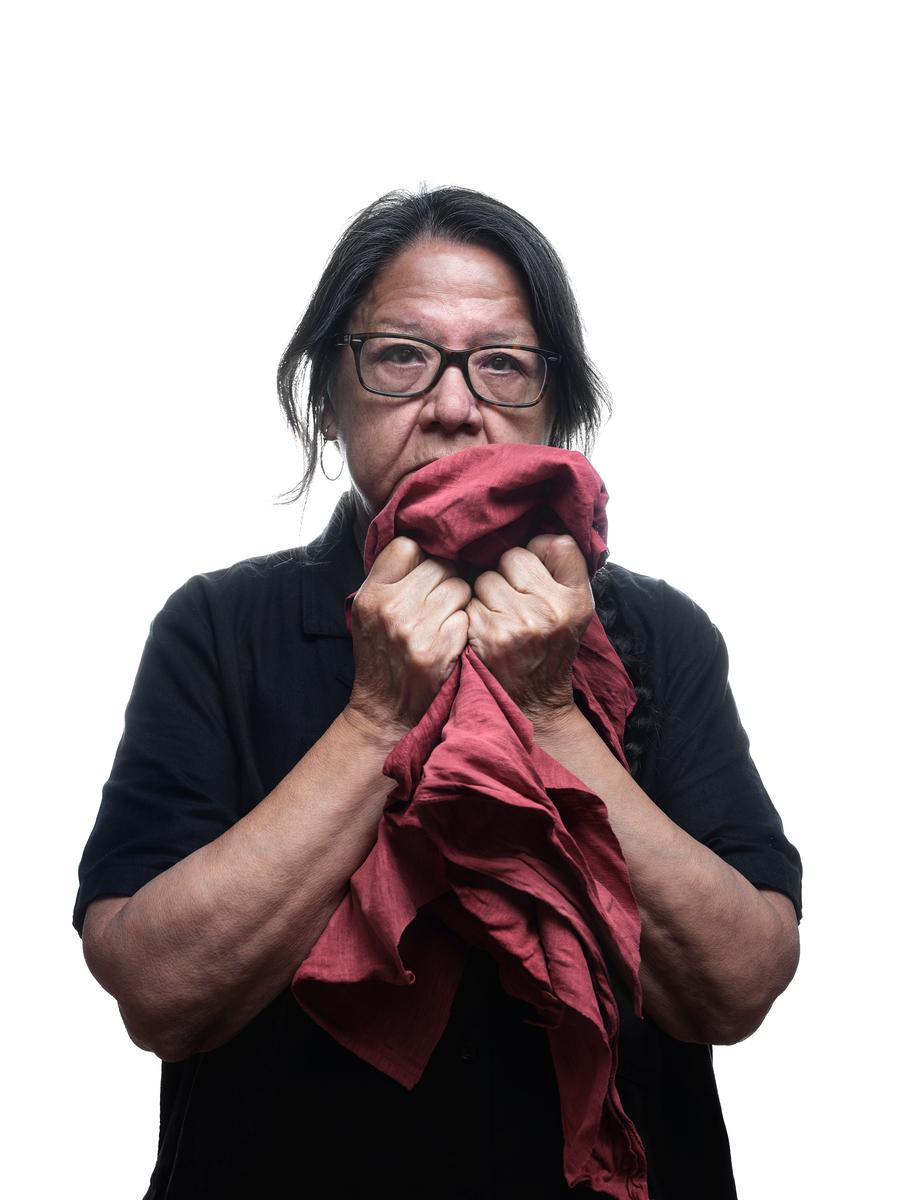
For the award-winning Indigenous artist and 2026 ECU Honorary Degree recipient Faye HeavyShield, artmaking is a process that engages all her senses through which to tell her family story.
Faye HeavyShield views her artmaking as a form of time travel where her ancestors and family members have a hand in steering her path and where their stories are infused into her work.
“There’s no way that my grandma’s voice is forgotten. I recall my dad’s voice. My mom’s time is too strong. I see old drawings, and I see the line. I see the line of the coulee. I see the line of the river. I’m very attracted to the notion that we are cellular.”
Growing up on the land of the Kanai (Blood) Nation in Southern Alberta has deeply shaped Faye’s work and the winding river, whistling prairie grass and coulees that she still lives amongst inspire her powerful installations, sculptures and projects.
“It was not a dream like I always wanted to be an artist. I just always wanted to be me.”
As the 2021 recipient of the Gershon Iskowitz Prize and an artist who has exhibited her work worldwide, Faye is drawn to repeated motifs that speak to her love of the environment around her through the spirals, circles, grids and lines.
For her first solo exhibition at the Art Gallery of Ontario (AGO), Faye was intentional about reflecting on her ancestors, in her restaging some of her seminal works, such as the resonant 1995–96 multimedia installation Venus as Torpedo. This large-scale work, with audio in both Blackfoot and English, features assorted garments draped over a protruding arm that extends across the museum floor.
“Everything is rooted in the family art. When we were there [at the AGO], it was important that my daughter speak to [our ancestors] and say, ‘We’re not here to disturb. We’re here to ask for your blessing.’”
Throughout her career, Faye has looked to the environment and drew on her senses as a vital source of inspiration, where any snippet of conversation or a glance at the land could be the key to a new work. Whether it was her grandmother telling her stories or watching the world go by, “this environment feeds my work. It is an entity.”
“It’s about smell. It’s about sight. It’s about sound. [Or] there’s a conversation that I’m listening to that I’ll respond to. Maybe not so much about me making art, but art making me. The wind or the river. They’re not separate from each other.”