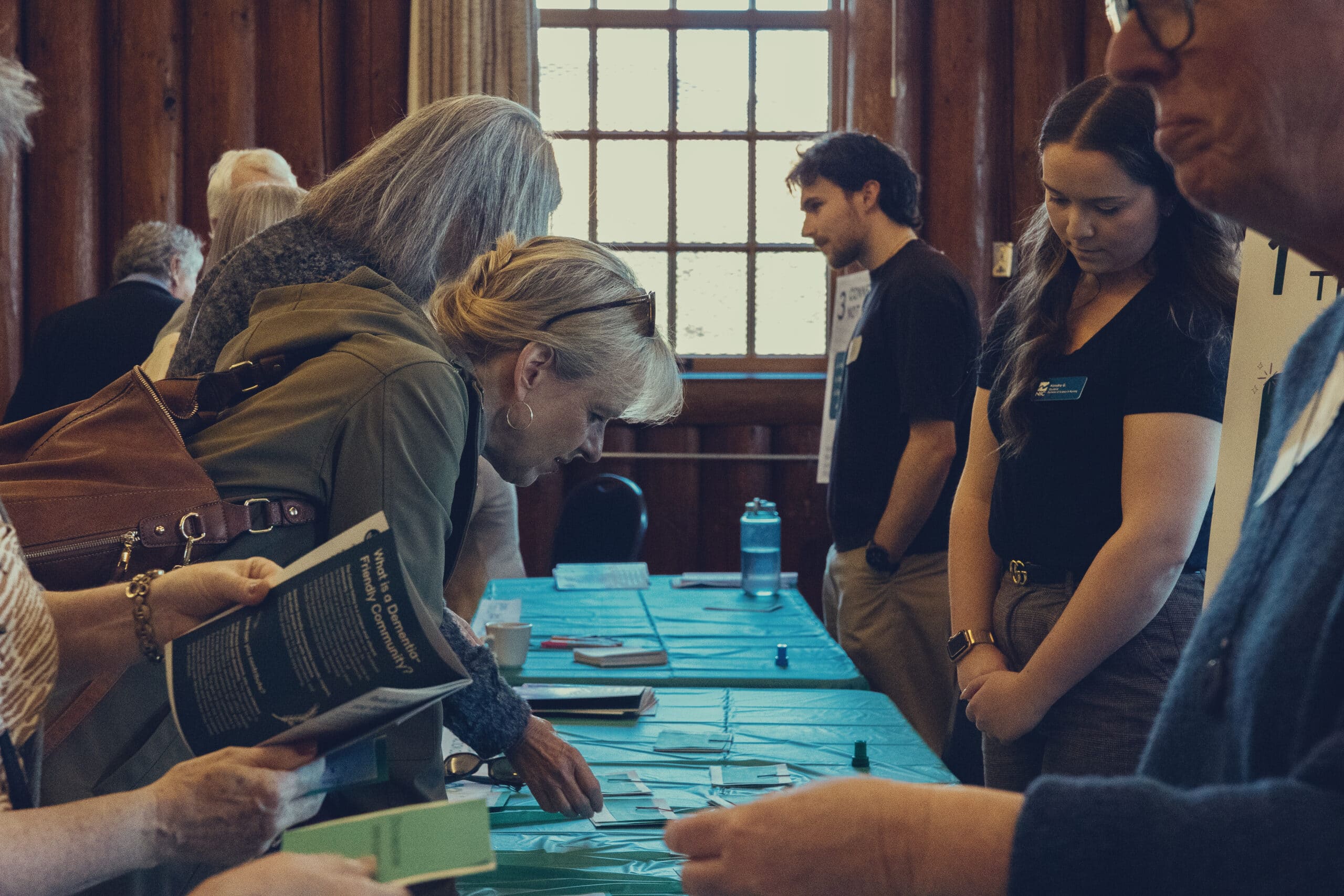
In collaboration with students and researchers at the University of Victoria and health partners on Vancouver Island, Working Together saw the Health Design Lab at ECU work with Comox Valley residents to create community resources.
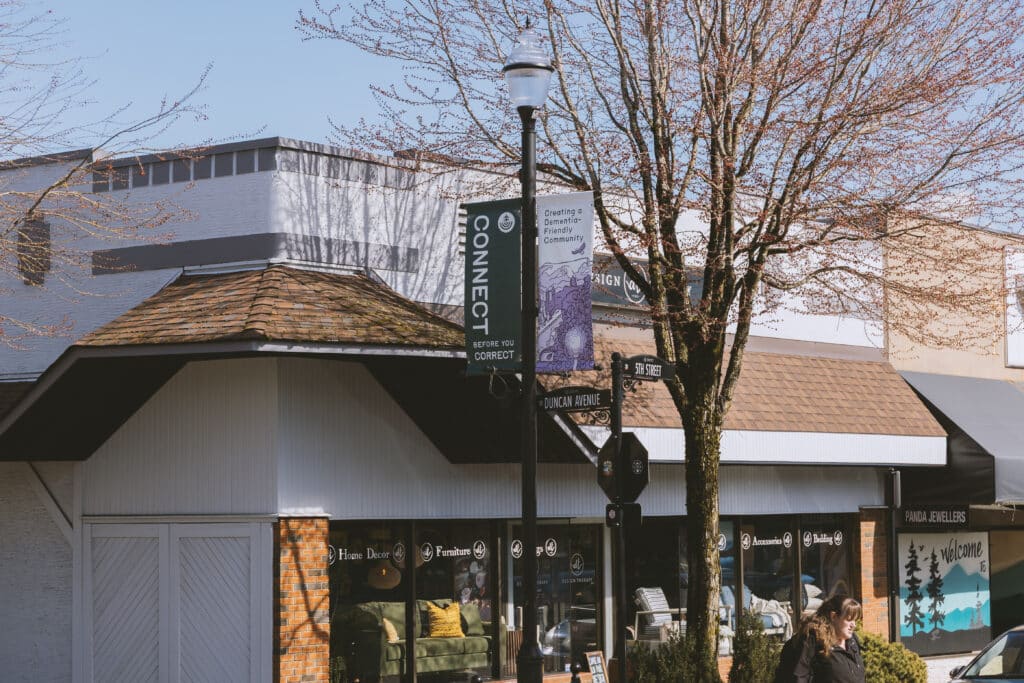
A public installation in Courtenay, BC, showcased the work of students at Emily Carr University of Art + Design (ECU) on a collaborative project to foster a dementia-friendly community through education and training for local businesses.
In partnership with the University of Victoria (UVic) CARING Dementia Collaborative, the Health Design Lab (HDL) at ECU, Island Health and the Comox Valley Healthcare Foundation, Working Together brought together students, researchers, Comox Valley residents with lived experience of dementia to co-design resources about dementia for people working in the Comox Valley.
“From the perspective of professional practice, working on this project was very, very helpful,” says Jessica Ruffolo (BDes 2025), a Communication Design major and research assistant with the HDL whose contributions included participating in workshops, illustration and leading art direction for the project’s publication. Jessica joined the project after participating in the HDL’s Perspectives and Who Cares? participatory design projects.
“It was very special to work with people outside of an institution, and I learned a lot of professional skills through those interactions. Talking with local people, researchers from other universities and people working in health organizations — and doing so through the lens of the HDL’s co-design principles — was a very valuable experience for a young designer.”
ENGAGING AUTHENTICALLY
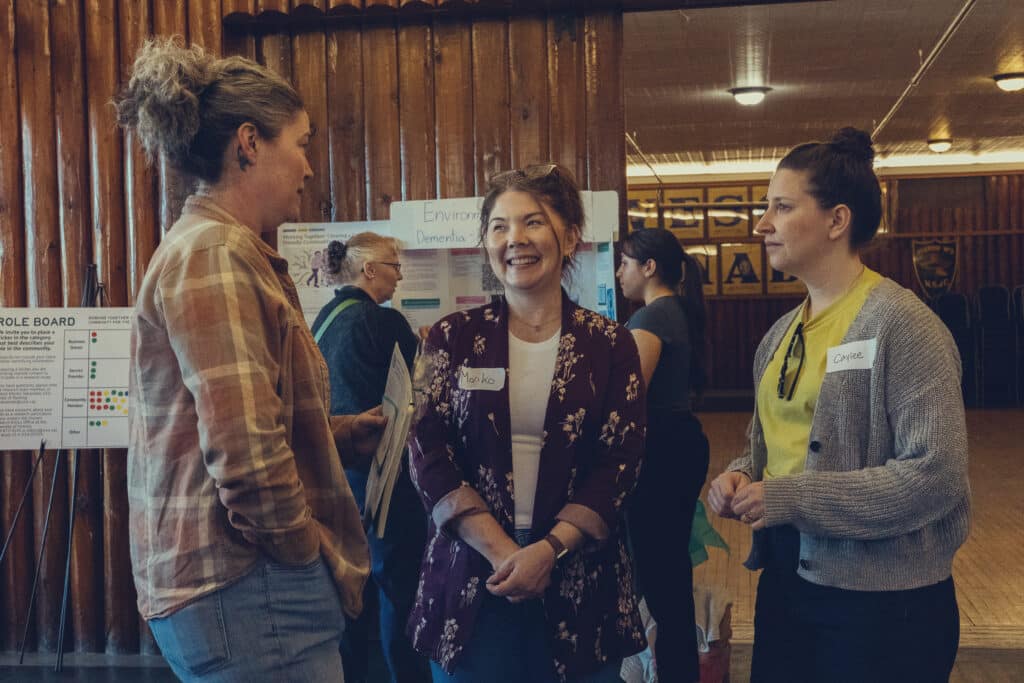
Led by UVic faculty member and Dementia Action Co-Lab founder and director Dr. Mariko Sakamoto, Working Together also included HDL director Caylee Raber, ECU faculty member Jon Hannan, ECU staff member Otilia Spantulescu, and ECU students Cancan Jiang and Fatemeh Pourseyed. Over five months, the team met for collaborative discussions and workshops with the Dementia-Friendly Partners group: six Comox Valley residents with lived experience of dementia. The group exchanged stories about the challenges and misconceptions experienced by Comox Valley residents affected by dementia and identified key lessons they wanted to share with local businesses, workplaces and employees.
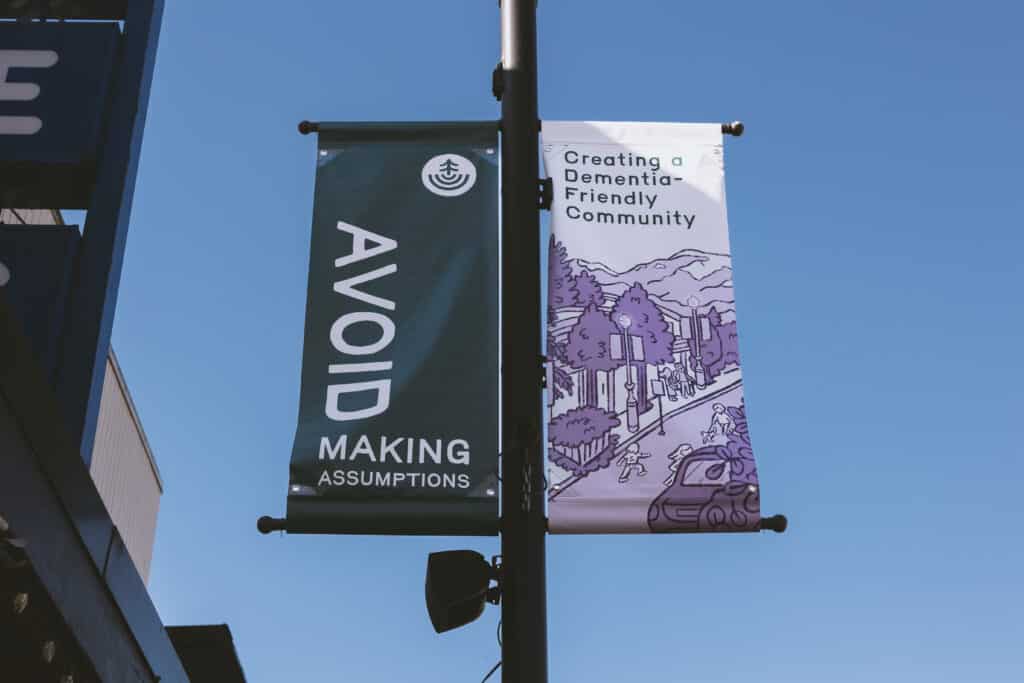
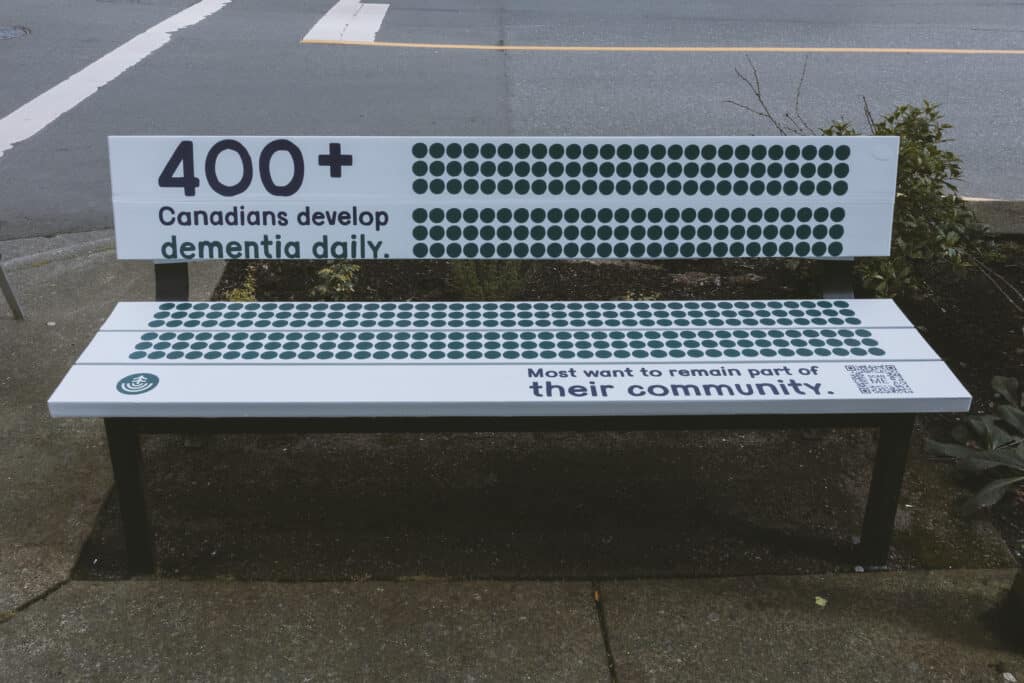
In addition to a booklet which was produced for local businesses, the public installation included street banners, infographics on benches and window decals along the main street in downtown Courtenay, BC. The installation was created with support from creative producer and communication designer Samantha Pineda and Heather Neale Furneaux, writer and research coordinator with the Dementia Action Co-Lab.
Mariko notes that all these materials reflect participants’ lived experience — a crucial distinction given the amount of generalized information that already exists.
“There are a lot of resources already out there, but that doesn’t mean individual communities are necessarily going to use them,” says Mariko, a former community health nurse.
“If you engage authentically and take the time to get to know people and find out what they want, you can transform all the great work that’s already been done into something truly meaningful for that specific community. When people see something has been developed by their community and for their community, they are more likely to engage with it in ways that they might not if it was on, for instance, a general-purpose website somewhere.”
SUPPORTING RESEARCH IN HEALTH SPACES
HDL director Caylee Raber notes Working Together provides a perfect example of the ways the HDL can offer unique collaborative opportunities for students and community partners.
“From a student perspective, this project gave Jessica an opportunity to learn how the technical skills from her degree studies can be applied in a community context,” Caylee says.
“In terms of the work we do at the HDL, this project shows how we can support other academics and researchers who are working in these kinds of health spaces. Mariko and her team have expertise in nursing and dementia, and the HDL can collaborate from a process and participatory perspective and bring certain visual skills to create a strong impact.”
DESIGN WITH REAL PURPOSE
The resources have been distributed throughout the Comox Valley community with support from Island Health, the Comox Valley Healthcare Foundation, Comox Valley Community Foundation and community participants. The resources will also be used to support education sessions and workshops offered by UVic for businesses in the Comox Valley. Additionally, Mariko will be presenting the project’s findings at a major Canadian gerontology conference in the fall.
Jessica adds that her time with the HDL comprised a defining moment for her evolution as an emerging designer.
“My experience with the HDL was genuinely the highlight of my career at ECU. I value it so much,” Jessica says.
“It was incredibly rewarding to feel like my designs had real purpose. For me, design isn’t just about making something pretty. It’s about helping people or being in service in a way that makes people’s lives better. I could see my designs doing that in a tangible way with this project, and I consider that one the greatest privileges of my time as a student.”
Learn more about Working Together via the HDL’s website.
More About the Health Design Lab
The Health Design Lab (HDL) is a research and design centre at ECU. We use participatory design methods to catalyze, support and amplify initiatives that address complex health challenges.
To us, health is more than healthcare. Health is about community, culture, equity, agency, and much more. As a team of designers, including faculty, research associates and students, we work collaboratively with communities through storytelling, visualizing, making and co-design. Collaborations and projects seek to foster new ideas, uncover needs or opportunities, improve systems and services, and amplify voices and stories.
Visit our website to find out how to partner with and support the HDL.
More about Research at ECU
As one of the most research-intensive art and design universities in Canada, ECU connects art, media, and design practices with some of the most pressing questions of our time. At ECU, we believe our research can help to transform the world, build healthier and more vibrant futures, and cultivate cultural resilience throughout our local and global communities and industry partners.
Visit our website to learn more.
Want more stories like this one delivered twice a month to your inbox?
Subscribe to our FREE Emix newsletter today!