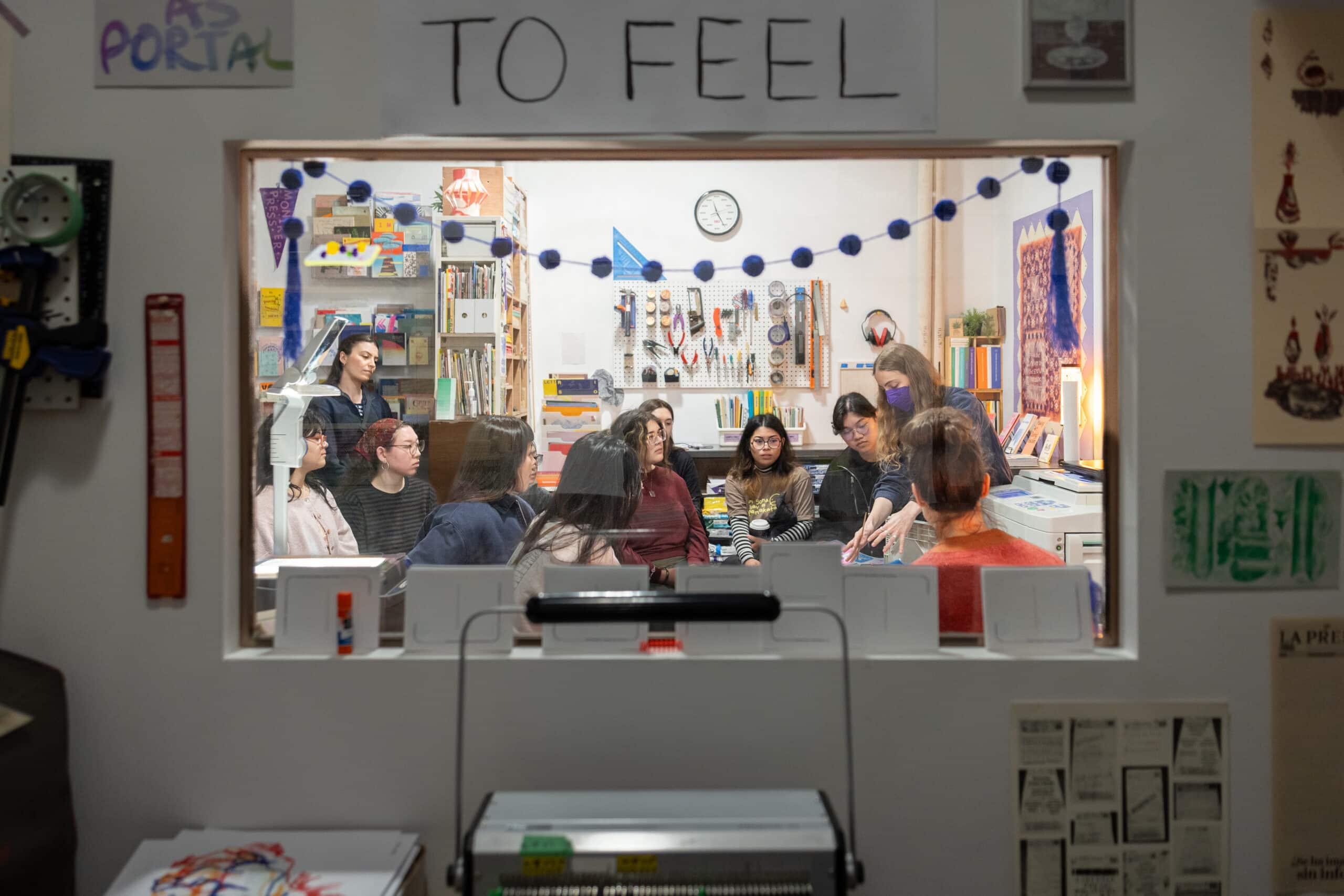
The visit was part of Pathways for Creative Futures, a work-integrated learning program from Shumka Centre for Creative Entrepreneurship that blends coursework with practical experience.
A recent tour of the Moniker Press publishing studio gave fourth-year students at Emily Carr University of Art + Design (ECU) an opportunity for meaningful engagement with a creative entrepreneur.
Visual Arts student Margaret Browning says hearing from Erica Wilk (BFA 2011), the artist and ECU alum behind Moniker, provided an accessible and encouraging example of how a working artist can make a living.
“I do a lot of bookmaking, and seeing someone who has built the practice into a business was really inspiring,” says Margaret, who studies Print Media and Curatorial Practices.
“Being in an artist’s space and hearing them talk about their work helped clarify how a career can be built after graduation. Plus, Erica’s work is so intricate and inventive. It all felt very encouraging, and I could see my peers’ eyes lighting up as well.”
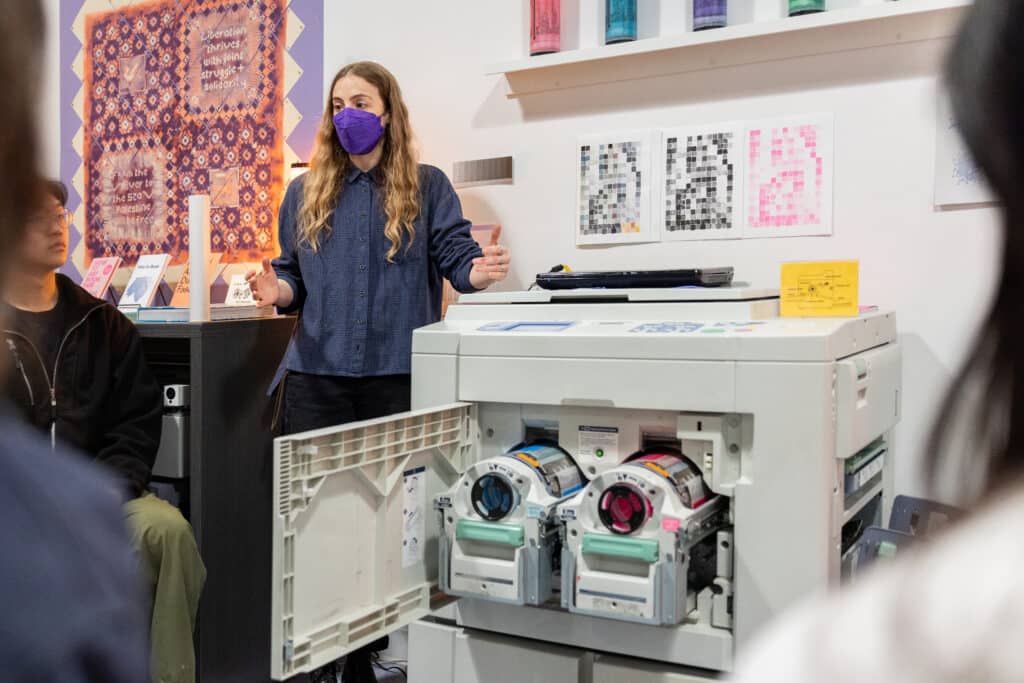

The studio visit was part of Pathways for Creative Futures, a programming series from the Shumka Centre for Creative Entrepreneurship at ECU. Blending academic learning with practical experience, the Pathways program provides innovative work-integrated learning opportunities in partnership with industry, community organizations, artists, curators and cultural workers to enhance the creative sector’s resilience and develop a strong talent pipeline.
The latest edition of the program extends support to more than 450 students through a series of interconnected applied-research projects embedded within coursework.
Pathways for Creative Futures is funded in partnership with the Business + Higher Education Roundtable and with support from the Government of Canada.
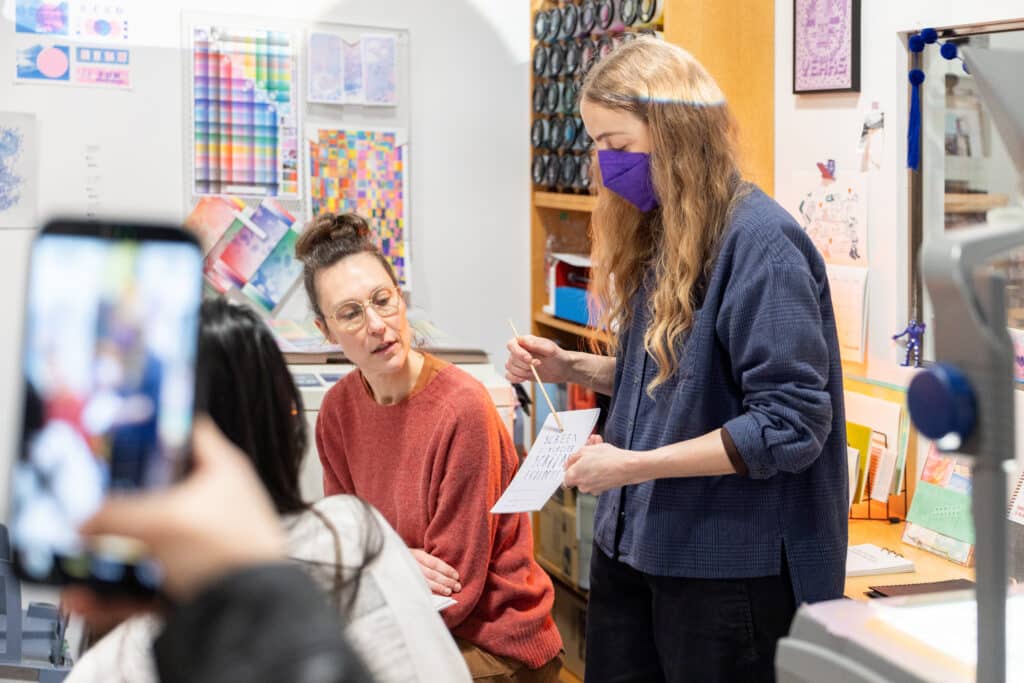
“Pathways was developed to bridge the gap between studio-based learning and the realities of building a career in the creative sector,” says Priyanka Poulose, Program Development Officer, Creative Industries + External Engagement at ECU.
“What’s been especially valuable is giving students direct access to working artists, design professionals and cultural leaders. They’re bringing real-world perspectives and professional expertise into the classroom, which helps students see how their work can translate beyond school and into different kinds of creative futures.”
The visit to Moniker Press was co-facilitated by artists and ECU faculty members Beth Howe and Mark Johnsen. Beth, who taught Erica Wilk during her undergraduate studies, says her example helps illuminate a complex moment in the career of an emerging artist.
“Visiting the studio of a professional artist can demystify the transition from art school to professional practice. Students can come in, look around, and perhaps imagine creating a workspace like that for themselves,” Beth says.
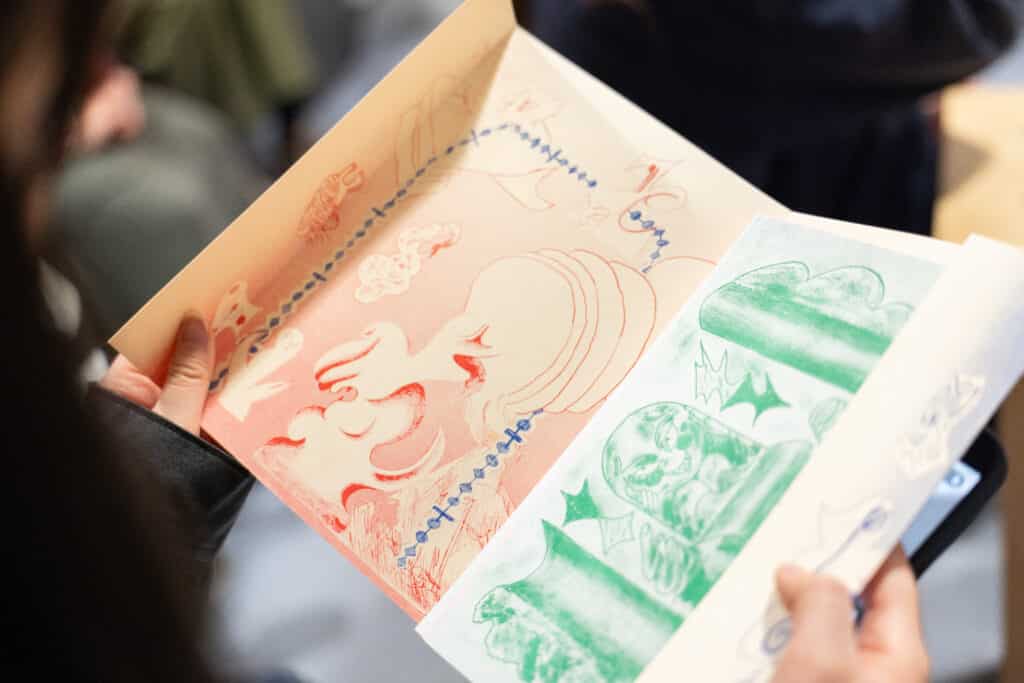
“Over 12 years, Erica built an active and thriving risograph-printing business, artistic practice and network of relationships in the Vancouver arts community and beyond. I think it can be reassuring for students to hear that it didn’t happen instantly — she built it slowly, bit by bit.”
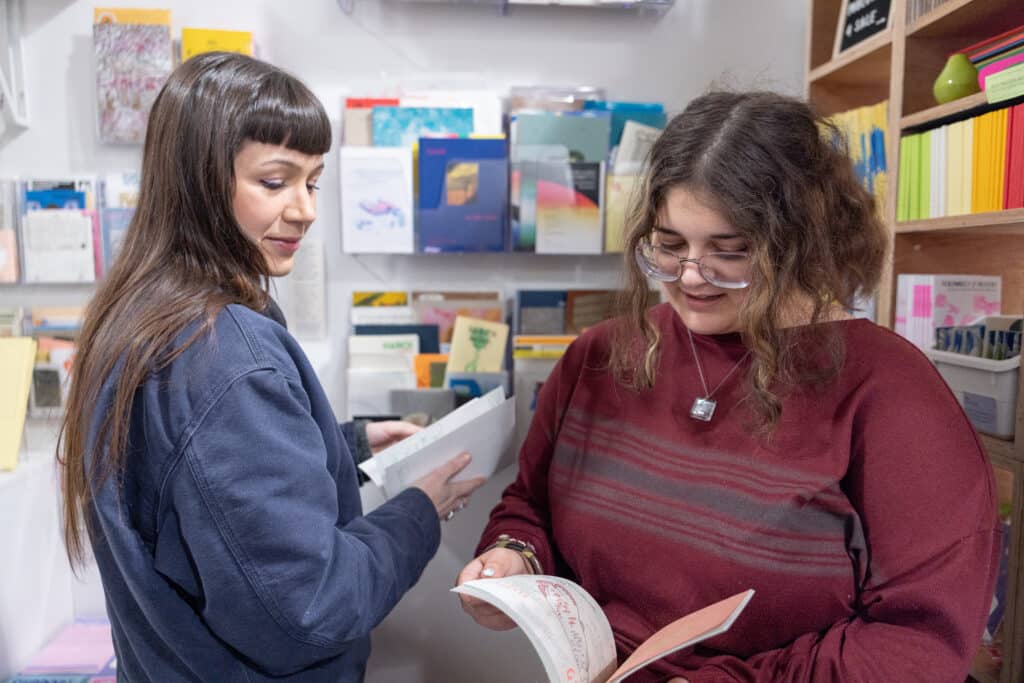

Erica notes her growth as an artist was supported immeasurably by other artists, including Beth, ECU Provost + Vice-President Academic Diyan Achjadi, Richard Clements and the late Jo Cook. Her gratitude for their contributions animates her enthusiasm to pay it forward.
“It was not that long ago I was a student myself, so it feels a bit surreal and full circle to now be able to talk to and hear from current students,” Erica says. “The early years post-graduation can be quite challenging for various reasons — they were for me at least — so this studio visit was an opportunity to reflect on what I have learned over the years and to share what I think might have been useful for me to consider when I was a student.”
Margaret affirms Erica’s message, noting that it answers some of the questions she has begun asking as she approaches graduation in May.
“When we hear from artists who are decades into their career, it can sometimes be difficult to understand how they got there from being a student,” Margaret says. “Hearing from Erica about that time in her career was nice, especially because she’s working toward a different type of practice. I walked away realizing it doesn’t happen overnight. That felt very reassuring and took some of the pressure off this moment where I’m about to graduate.”
Visit Shumka Centre’s website to learn more about Pathways for Creative Futures.
More About Print Media at ECU
Engage in immersive studio courses and critical studies that explore print media’s historical and modern facets. Experiment with various printmaking techniques using specialized equipment and facilities, developing a unique artistic practice.
The curriculum emphasizes understanding the global histories of print media and its intersections with fine art, popular culture, mass media, propaganda, marketing and social movements.
Visit our website to learn more.
More About Shumka Centre for Creative Entrepreneurship
Shumka Centre is a place where creative practitioners can find the community, knowledge, and resources they need to launch, fund, and organize projects across the spectrum of contemporary art and design activities – products, projects, curatorial initiatives, platforms, companies, organizations, and more. By offering tactical support tailored to the unique needs of artists and designers, the Shumka Centre strives to foster systemic change and amplify creative potential.
Visit their website to learn more.
Want more stories like this one delivered twice a month to your inbox?
Subscribe to our FREE Emix newsletter today!