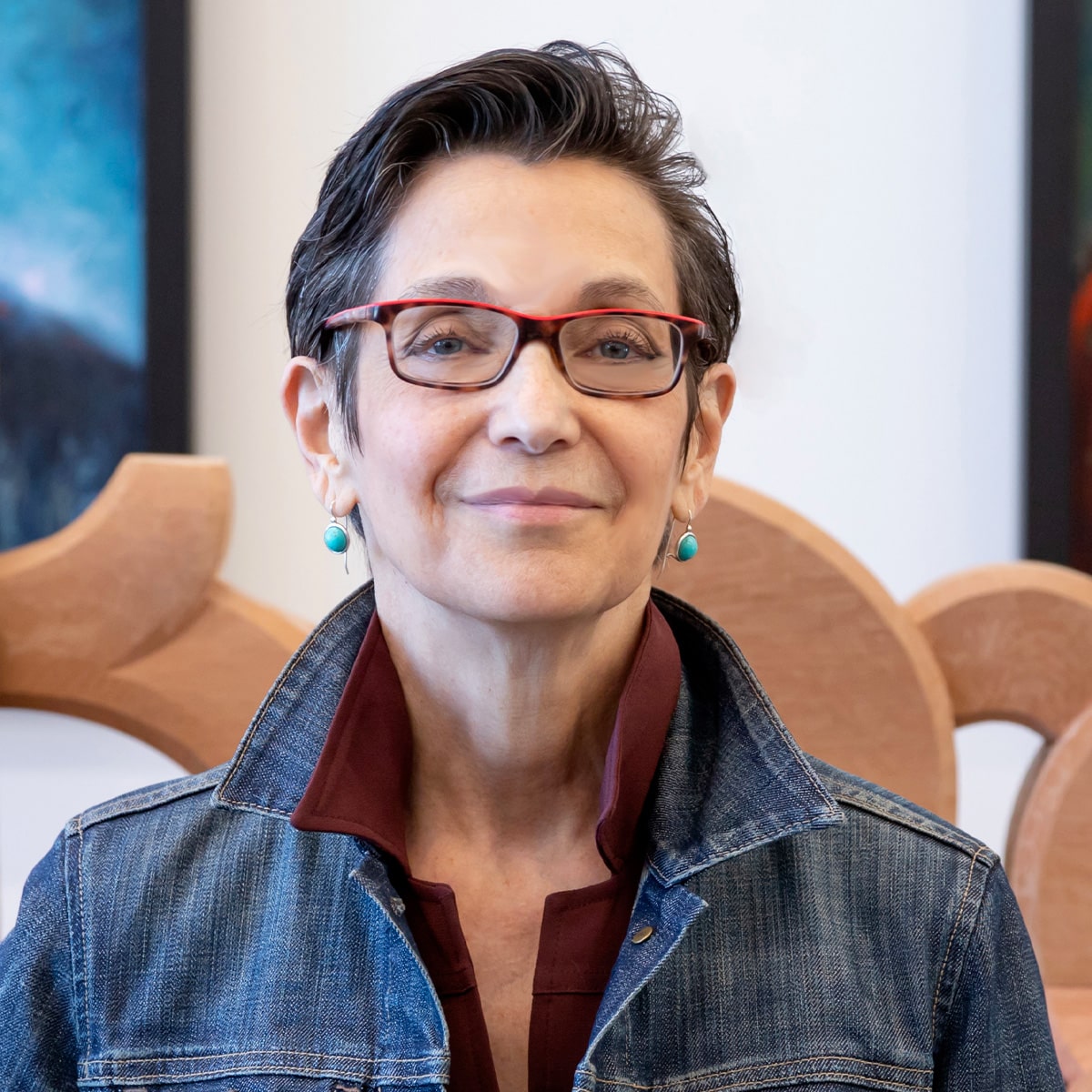
Mimi Gellman

Associate Professor, Faculty of Culture + Community and Special Advisor to the Provost, Indigenous Curriculum Initiatives

Availability:

Education:

PhD
Queen's University
Master of Visual Studies
University of Toronto

Bio

Dr. Mimi Gellman is a Métis artist and educator with knowledge of Indigenous studies, decolonial aesthetics and the pedagogy of place. She has a multi-disciplinary practice that includes works in drawing, textiles and installation. She has a PhD in Cultural Studies from Queen’s University and a Master of Visual Studies degree from the University of Toronto. She exhibits internationally and was included in "On Line, Drawing Through the 20th Century" at the Museum of Modern Art in New York. Her work can be found in the collections of Price-Waterhouse, Kraft/General Foods Corp, the Toronto Transit Commission and Rogers Stadium.


Research Interests

Mimi researches traditional Indigenous material practices, exploring the intersections between Indigenous material innovation, creative resilience and aesthetic sovereignty. She is interested in the relationship between quantum physics and Indigenous Science paradigms which she investigates through an embodied practice of walking and mapping, and through works and installations that point to the animacy and agency of objects. She has delivered keynote addresses and lectures for the Jackman Humanities Institute, NAISA (the Native and Indigenous Studies Association of America) and the College Art Association, among many others. Her essays can be found in Canadian Art Magazine, C- Magazine, in the edited volume of “The Impact of Co-Production”, Bristol University Press, and in the recent publication, “Leaning Out of Windows: An Art and Physics Collaboration.” Her PhD thesis, “Between the Dreamtime and the GPS/ The Metaphysics of Indigenous Mapping” is currently being adapted into a book for the University of Manitoba Press.

24/25 Courses

Course Name Department Course Code Term
Foundation Studio Courses FNDT 115 26/SP

Description

This foundational course introduces students to Indigenous peoples, worldviews, cultures, and ways of knowing through the lens of contemporary Indigenous artists and their cultural expressions. Situated within a basket of Indigenous values, this curriculum privileges Indigenous presence and the gifts that Indigenous cultures have contributed and continue to contribute to the social, ecological, cultural and political fabric of Vancouver, British Columbia and Canada. Through thematic based lessons, presentations, interviews, readings and films, we will trace important moments in Indigenous histories emphasizing the diversity of Indigenous peoples in Canada and North America. This course will also track the impacts of Indigenous-settler relations as they inform our current historical moment and aims at decolonizing our lenses and developing an understanding and validation of a plurality of knowledges and alternative histories. A central tenet of this course is understanding the spirit of place and the importance of the local, and the ways in which place informs us as artists, designers, guests and community members. By fore-fronting place and the land, we are situated, as teachers and learners, in a reciprocal, responsible relationship with the Indigenous ethos of "all my relations." An integral part of this course will teach Indigenous values through Indigenous material workshops that may include beading, brush-making and working with natural ochres. This course may also include field trips on the land and attending local Indigenous cultural events like powwows or Hoobiyee (New Year Festivals). Indigenous Presence can be taken as an elective in any of the four years of a program. All students are welcome in this course.

Pre-requisites

No prerequisites.